
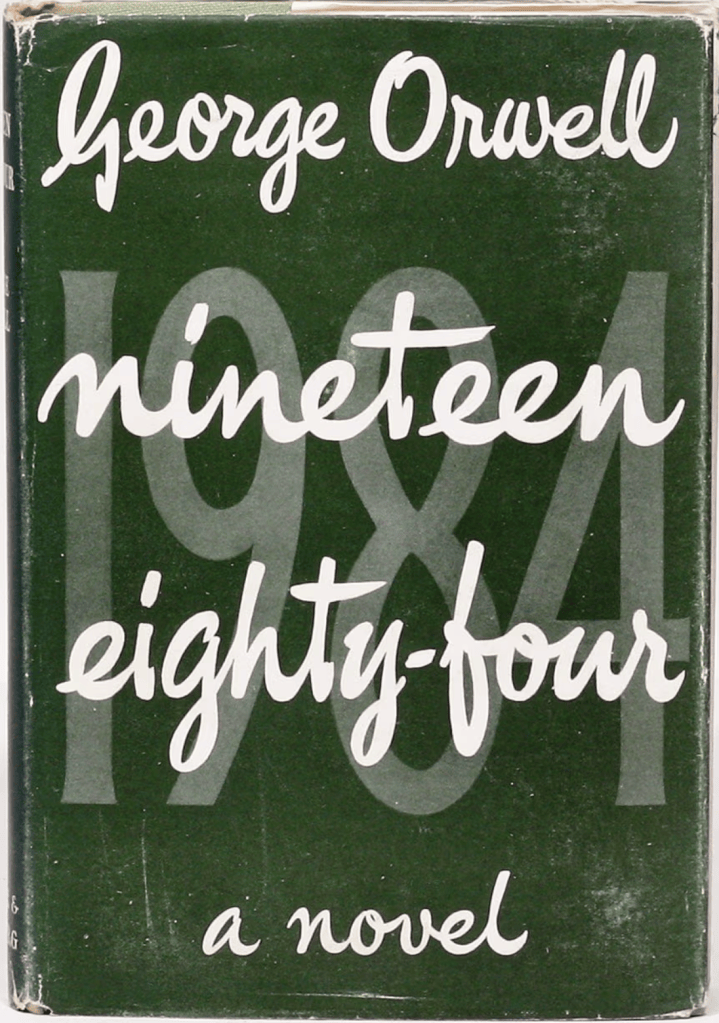
1984, by George Orwell
Undoubtedly the most famous dystopian novel ever written, 1984 grew out of George Orwell’s encounters with Soviet-backed Communists during the Spanish Civil War, and his service with the British government’s Office of War Information during World War II.
It tells the story of Winston Smith, a low-level bureaucrat and “Outer Party” member in the dystopian Communist” (but I repeat myself) Britain of 1984. In Orwell’s timeline, the world is divided among three superpowers: Oceania (British Commonwealth plus United States and Latin America); Eurasia (continental Europe and Russia); and Eastasia (China plus Japan’s wartime “Co-Prosperity Sphere”). All three are totalitarian one-party states, indistinguishable except for theoretical ideological differences. They are constantly at war, with shifting alliances in which the two weaker oppose whichever seems strongest.
Smith engages in a personal rebellion against the state by having an affair with a woman named Julia, writing critical notes to himself in a journal, and feeling disgusted with himself for going along with all the daily rituals of obedience and conformity. Eventually he is noticed, betrayed, arrested, tortured, and released as a broken shell of a human.
One extremely prescient element of Orwell’s dystopia is its pervasive shabbiness. Having seen the economic stagnation of the Soviet Union and other Communist states, this seems obvious and inevitable to modern readers, but in 1948 the Communists still claimed to be “more efficient” than messy market economies, so that (once the wreckers and profiteers were sent off to Siberia) scientific management would create a wealthier society. I think Orwell realized that because a poorer population is easier for the state and the Party to dominate, no totalitarian regime really wants to let its people get rich. The only route to a better life that a state like Oceania can allow is via advancement within the Party, because anything else is a threat.
An element of 1984 which I think some people fail to notice is that the true horror of life under the Party isn’t being a victim to the oppressive nature of Oceania’s society — it’s the participation in it. Orwell shows the seductive temptation of the daily “Two-Minute Hate” which should be familiar to anyone who has seen a political conversation in the past decade. The Party doesn’t just force its people to repeat lies, it makes them want to do it.
Influence: Undoubtedly A+ for influence — this is simply one of the most influential books of all time. One index of its influence is that both sides in any political contest will try to slot their opponents into the roles of Big Brother and the Party, sometimes performing some literally Orwellian intellectual and verbal contortions to justify it.
Literary Quality: I give it an A. Orwell’s writing is extremely effective, and his characters are well-developed. Because a one-party state like Oceania deliberately tries to destroy normal human relationships and emotions, it’s hard for readers to find Winston and Julia sympathetic, but that’s kind of the point. As with Brave New World the plot of the novel is secondary to its depiction of a nightmare society.
Originality: I’m going to give Orwell a B for originality. While 1984 caused a sensation with its depiction of life under totalitarian rule, the sad truth is that any number of Russian emigres and Western anti-Communists had been beating the same drums since about 1920. Nobody listened. They still don’t.
Science Fiction Quality: Again, 1984 gets a B when viewed as a work of science fiction. Its technological speculations are little more than window-dressing. Big Brother’s Oceania isn’t a fictional society — it was a horrifying reality to more than a billion people in the real world, and still lingers in places. (That being said, Isaac Asimov once wrote a critique of 1984 as science fiction, and it’s one of the most fatuous things I’ve ever read.)
Overall: Averaging the ratings gives 1984 a rating of A- overall. Like Brave New World and a few others, its influence far outweighs its actual quality as a story to read. And of course Orwell wasn’t trying to write a jolly adventure in Airstrip One, he was trying to grab the literati of the West by the lapels and scream a warning into their faces.
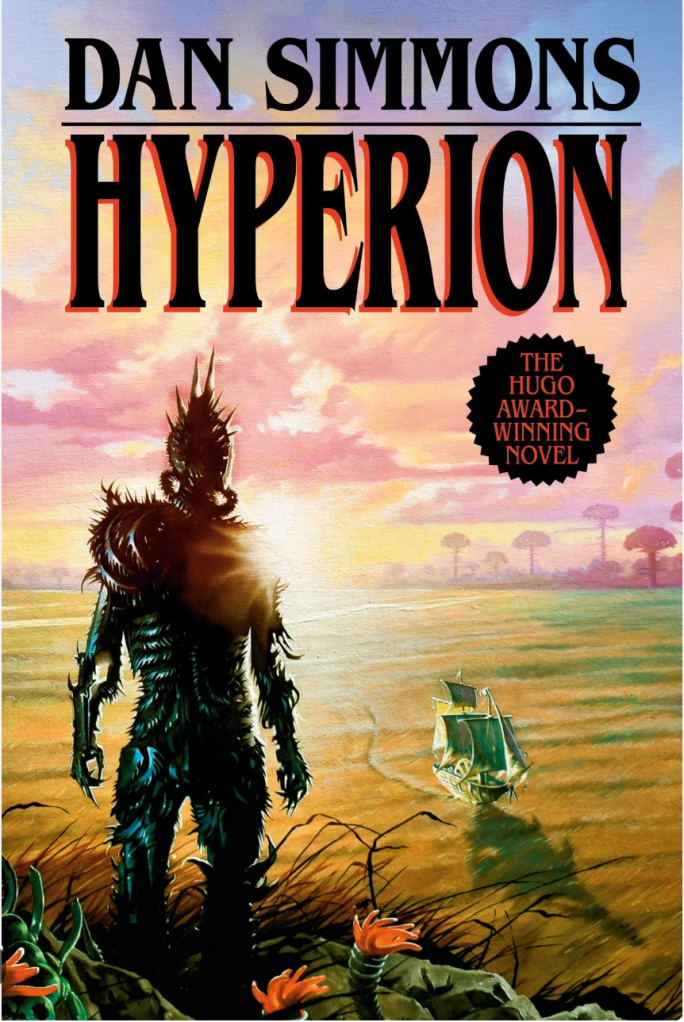
Hyperion, by Dan Simmons
This book is a tour de force. Six characters on a pilgrimage to a complex of mysterious structures called the Time Tombs on the eponymous planet Hyperion tell their backstories to each other. There’s a priest, a soldier, a poet, a scholar (whose daughter is aging in reverse), a detective, and a traitor. Each character’s story is a different genre, told in a different style. Along the way the book examines concepts of faith, grace, redemption, predestination, the nature of humanity, and probably half a dozen others. It’s a big, dense book, almost overwhelming — but in a good way, like a Beethoven symphony or a six-course dinner.
The setting is vastly complex and rich, far too much to summarize in anything shorter than the novel itself. The six narratives dovetail and feed into each other, presenting the reader with a larger story. And it all ends on a cliffhanger which you’ll either find exhilarating or frustrating. There is a sequel, The Fall of Hyperion, which resolves some (but not all) of the plot threads begun in Hyperion.
Dan Simmons, like some other writers, seems to like trying different things. He’s done horror, science fiction, historical novels, and a lot of books that are hard to categorize. He could easily have turned Hyperion into a series as long as Herbert’s Dune sequels, but I think he decided he had said all he wanted to say about that setting.
Influence: The book was well-received when it came out, and had a sequel and a couple of related works. It has remained in print but never broke out to other media the way Simmons’s The Terror did. Its very uniqueness means it didn’t inspire any imitators. Among SF readers over thirty it’s famous, but I fear many younger readers may not have heard of it. I give it a B in this category.
Literary Quality: Dan Simmons is a great writer, and I think this is his greatest work. It shows a real command of different literary styles and grapples with some very profound topics. As in a lot of other science fiction, the characters at times seem more like archetypes than people. I think it rates an A.
Originality: Again, I give Hyperion an A. The universe he presents is very different from the run-of-the-mill space opera setting, and his Canterbury Tales method of telling the story was a stunning innovation.
Science Fiction Quality: Specifically as science fiction, Hyperion gets an A- from me. Simmons’s worldbuilding is strong, but he does fall back on some SF tropes which were already starting to show their age in 1989, and a lot of the story elements might as well be magic.
Overall: The average of ratings for Hyperion comes out as A-, actually slightly ahead of 1984 even though they both get the same letter grade. A lot of the books in this series have that rating — but of course we’re talking about works which everyone acknowledges as great SF novels. We’re just trying to pick out the best of the best.
The next post will be an extra-large one, to cover the three remaining novels on our list of candidates, and reveal the winner. I plan to do a final “cleanup” post in the series discussing the winner and some books which barely missed being on the list.


4 responses to “The Greatest Science Fiction Novel Ever (Part 5)”
These are both great books. “1984” is as relevant as ever, and truly terrifying.
I have long felt that “Hyperion” would make a fantastic series on streaming or something. It is such an amazing book, and an adaptation would help younger readers discover it. I think of “The Fall of Hyperion” as the continuation of the same story, although it shifts to a more conventional structure, the individual stories having been told.
LikeLike
One thing it took me way too many readings to notice is how the essay at the end on Newspeak undermines the sense the novel gives that the boot really will be stamping on a human face forever. From clues in that text, it’s clear that not only did IngSoc and its linguistic project not last forever, it didn’t even last that long past the end of the novel. (IIRC, the edition of the Newspeak dictionary that’s being worked on in the main text is noted as never having been finished.)
From other writing, I think Orwell did think that planned economies were more efficient– during WWII he kind of despaired of Britain’s comparative inefficiency compared with both the Germans and Soviets. I’m not sure he lived long enough to fully learn of the mess the Nazis made economically underneath the Riefenstahlian gloss. And people more skeptical of Communism than he was were quite worried that the Soviet command economy would work better than it did, long after his lifetime.
There was a real fear in Orwell’s writing that liberal democracy might be better to live under, but that it just couldn’t compete with systems that could directly coordinate things to achieve their goals. His own preferred option, non-totalitarian socialism, presumably was an attempt to square that circle. (I don’t think he was particularly conscious of things like the calculation problem, or the signaling role of prices, insofar as those had even penetrated into general economic thought.) One of the reasons he thought adopting it was so urgent was his conviction that nothing else stood a chance of standing off totalitarianism.
But even if he overestimated the productive potential of central planning, he at least recognized that totalitarians had no particular reason to focus all that economic power on consumer welfare. Especially when being on a permanent war footing with all that productive surplus being regularly blown up was better suited for consolidating power.
Granted a real Inner Party would likely at least have granted themselves more luxuries than O’Brien’s did, even if they thought it prudent to keep the proles poor.
I do find it striking that for our generation one of the hallmarks of 1984 was the pervasive video surveillance, which now is just the unremarkable status quo.
LikeLike
Given that the Hyperion Cantos is 4 books long, it’s not that much shorter than the Dune Saga.
I read 1984 in highschool for english class. I already know the dangers of Communism, so I’ve never felt the need to re-read.
LikeLike
I was waiting for the 1984 installment to mention my recollection of Asimov’s review of the novel, particularly his line denouncing it as “abominably poor” science fiction. You, however, beat me to it. (Asimov’s lone praise, as I recall, was for Orwell predicting the rough outlines of the three power blocs that did emerge.) On the very narrow point of being predictive about technology like the telescreen Asimov may have been right, but it’s a bit like criticizing Ray Bradbury for getting the evolving role of firemen wrong. (They were trying to prevent the future, Isaac, not forecast it. Though Bradbury’s wallscreens are getting fairly close, and we may be very near to seeing something like the Mechanical Hound in law enforcement.) Plus, of course, Orwell wasn’t trying to fit the novel into the niche of SF.
On LHN’s points about Orwell’s political philosophy, my pet theory is that he got capitalist economics bound up with Britan’s class system, and he perceived the two as all of a piece when they were really jammed together awkwardly. The true toffs scorned people “in trade,” after all, and resisted their rise into the elite. If Orwell had spent six months or a year in the United States, where he could see free markets working separately from the class system, he might have reached some very different conclusions. As with the Tootsie Pop conundrum, the world may never know.
I must count myself among those who found the Hyperion cliffhanger frustrating. Had I known it was there in advance, that the novel was the front end of a duology, I might have reacted quite differently. I came into Simmons’s Ilium/Olympos with that knowledge, and it served me well. Perhaps I will have to read Hyperion again.
LikeLike