
Another pair of powerhouses this time: Brave New World and The Left Hand of Darkness. Both are fundamentally examinations of societies, one a future dystopia and one an alien world.
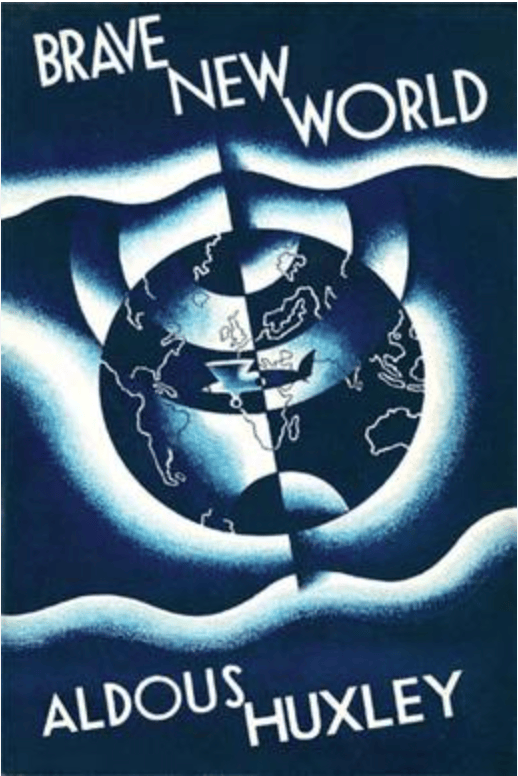
Brave New World, by Aldous Huxley
I first read this one in high school and thought it was unrealistic and implausible. I re-read it about a decade ago and my opinion changed considerably. In the 1980s, Orwell’s 1984 seemed like the more likely dystopia, but today Huxley’s vision is barely fiction at all. Brave New World‘s post-religious, hedonistic, atomized, bureaucratic civilization is what you see outside your window. We may not have embryo-tinkering — but how long until someone decides to CRISPR their kids (assuming it hasn’t been done already)? That’s about all that’s missing. Turns out you don’t need a world government to impose this society on anyone, either. People do it to themselves.
There’s not a whole lot of story in Brave New World. It’s one of the great “tour of the balloon works” novels, and the details of the society Huxley depicts are enough to carry the reader along. We follow one Bernard Marx, a dissatisfied member of the “Alpha” caste — the elite selected for high intelligence. He visits a “Savage Reservation” where people live and reproduce in the old fashioned way, and there he meets a man called John, who has grown up on the reservation and only read Shakespeare. John becomes a celebrity back in England (the book was written in 1931 when it still seemed obvious and inevitable that England would be the center of the World State), but is unable to stand the shallowness of the society and eventually kills himself.
The plot is hardly more complex than that paragraph outline, and of the characters in the story only two have any real depth. John, who is fascinated by the society of the World State even though he rejects it; and Mustapha Mond, the “Resident World Controller” for Europe, who is completely self-aware and shows a strange mix of cynicism and idealism about the World State and its goals. Everyone else is at best a comic caricature.
Still, it’s a heck of a book, and as I said, seems more plausible over time.
Influence: Along with 1984, Brave New World has been one of the most influential dystopian novels of the 20th century. It gets name-checked every time any new biotech advancement comes along. The weakness of the story does mean it has not translated to other media well, which may reduce its ability to reach people. I expect a lot of people have heard of it but not read it. Call it an A.
Literary Quality: As I mentioned, Brave New World does not feature a particularly compelling plot and the characters are not very profound. The actual writing is quite elegant — Huxley knew his way around a paragraph. Others might rate that as more important and put less value on story, but I’m giving it a B+.
Originality: Definitely rates an A+. This is one of the first books to depict a dystopia more or less seriously and show it as functional and successful. Most earlier social satires played for laughs. But I think Huxley had the scientific background to realize that everything he was describing was quite possible, and possibly inevitable. Without Brave New World I doubt there would have been a 1984, a The Handmaid’s Tale, or any of the tsunami of young-adult dystopian series of the past couple of decades.
Science Fiction Quality: I’ll give it an A- grade. One must allow for the fact that it was written in 1931, well before the discovery of DNA, so all the biological engineering is described in terms of embryo modification instead. By the same token one can’t fault Huxley for not anticipating computers or other technologies nobody had gotten around to inventing yet. I will knock it down a couple of notches because of Huxley’s tendency to let his satire override his speculation. It’s hard not to roll one’s eyes at the calendar being “in the year of Our Ford,” and there’s always the lurking suspicion that everything might just be a metaphor.
Overall: The average score comes between A and A-, so I will give Brave New World the benefit of the doubt and give it an A overall.
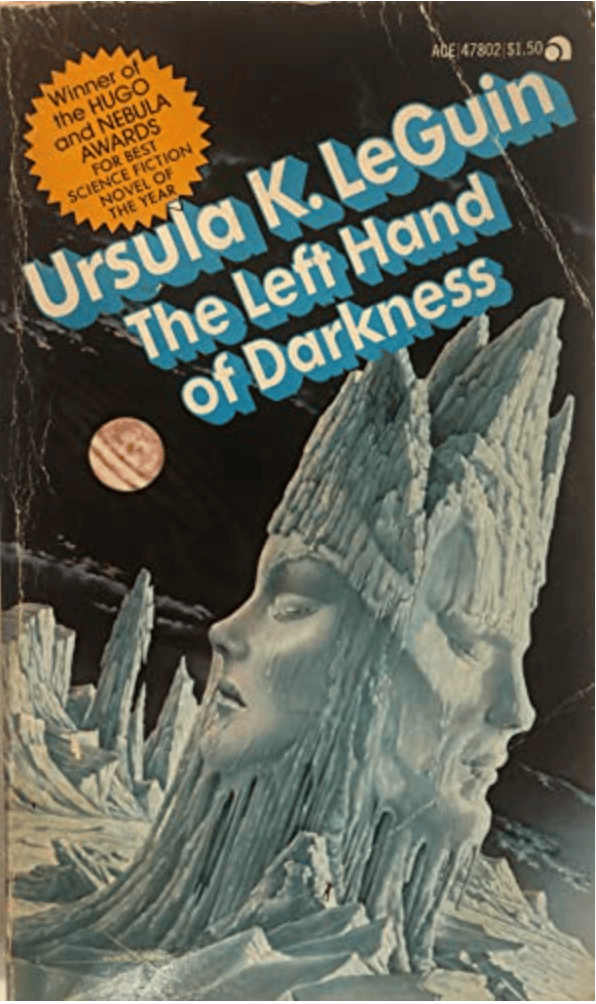
The Left Hand of Darkness, by Ursula K. LeGuin
This book is responsible for the delay in this blog post. When I went to re-read it I discovered we didn’t have a copy on the shelf — which is strange because I was sure we had one. Maybe I lent it to somebody and never got it back. Anyway, I had to spend a couple of days finding a copy and then re-reading the book.
The Left Hand of Darkness follows the experiences of Genly Ai, an envoy from a community of human-populated planets called the Ekumen, who has just arrived on a planet called Gethen, or Winter. This is one of LeGuin’s “Hainish” series of books, with a shared backstory that some eighty planets (including Earth) were settled by an ancient human civilization. This gives Ursula LeGuin the opportunity to depict a variety of weird and interesting human cultures, often stranger than most science fictional aliens.
What sets Gethen/Winter apart from the other worlds of the Ekumen is that its inhabitants are sexual neuters most of the time, becoming male or female only during a week-long period of “kemmer” every month. This, plus the incredibly harsh nature of their planet (it has an elliptical orbit giving it a brief mild summer and a very long cold winter) has affected the psychology and society of its people.
Genly Ai starts out in the kingdom of Karhide, where he is befriended by the political leader Estraven — until Estraven falls from power and is declared an outlaw for his contact with the envoy. Ai journeys to the totalitarian rival state of Orgoreyn, where he encounters Estraven again before the local regime arrests Ai and sends him to a brutal gulag. His claim of being an envoy from the stars is dismissed as a hoax, and he is called a pervert because he is perpetually “in kemmer” and male. Estraven helps Ai escape the prison and the two of them make a grueling journey across a vast glacier to the relative safety of Karhide.
As one might expect, much of the book involves exploration of Gethen’s unique culture, and a look at sex, gender, biology, psychology, and how all those things affect each other.
Influence: The Left Hand of Darkness made quite a splash when it came out, and the paperback edition was in print for many years. I think one could call LeGuin a “writers’ writer” rather than a crowd-pleaser, so the book influenced other science fiction and fantasy writers — especially the wave of feminist writers flourishing at the time — rather than fandom or the national culture at large. I would call its influence level an B+: an influential book among a small group of people.
Literary Quality: It is very well written, which is why The Left Hand of Darkness is one of the science fiction novels your high school English teacher recommends to you. The prose is not flashy but it’s quietly powerful. The plotting is good, though it’s not particularly complex. LeGuin’s restrained storytelling does mean that the book doesn’t give one an “epic” feeling. Like much of LeGuin’s work, this novel is good, it’s powerful — but it isn’t very fun. After much consideration I give it an A in this category.
Originality: Also very good. I don’t think LeGuin was the first to consider a society of people who can be either sex (though it was usually played for laughs). But The Left Hand of Darkness is definitely the definitive treatment of the idea. I give it an A in that category as well.
Science Fiction Quality: This book is definitely A+ material. It’s very rigorous science fiction and LeGuin obviously put a lot of effort into thinking through how Gethenian society would be affected both by the extreme climate, the sex-switching nature of its people, and their estrus cycle. Gethen does for ice planets what Arrakis did for desert worlds. Top-notch.
Overall: Averaging the categories gives us an overall grade of A, which seems about right. It’s a classic among SF fans, but not well known outside the field.

