
And here we are on the home stretch! Three final entries and then the big revelation!
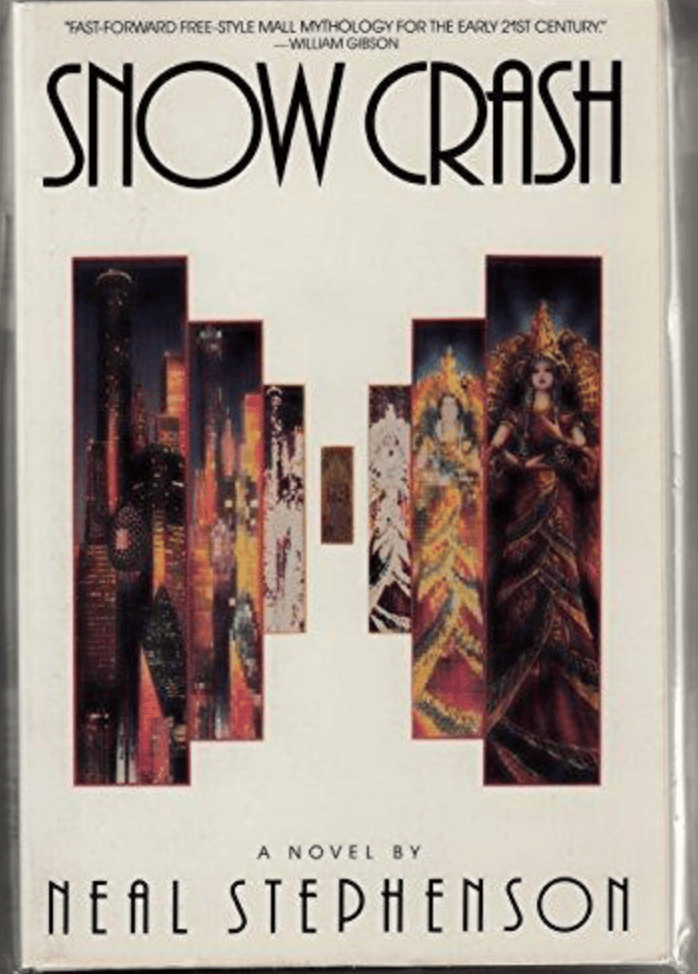
Snow Crash, by Neal Stephenson
This wasn’t Neal Stephenson’s first novel (that honor goes to The Big U), but it was his “breakout” book. It came out in 1992 and almost instantly turned Stephenson into a science fiction star. It also cemented his reputation as a technological pundit and futurist.
The novel apparently began as the story for a graphic novel, which explains why it’s told in a breathless present tense, soaked with visual detail. From the very first page it grabs the reader by the eyeballs and drags you along through exciting, hilarious, and weirdly cerebral adventures in the near future — which I put somewhere around 2010, at the latest. We’ve got our main character, Hiro Protagonist: hacker, swordsman, and pizza Deliverator. His sometime rival and sometime ally is the teenage skateboard courier Yours Truly. The supporting cast includes a biker with his own nuclear arsenal, the Godfather of the Mafia, a villainous cable-TV mogul who literally gets his mustache waxed while he plots, and the deadly but ultimately endearing Rat Thing.
All of them bounce off each other in a Brownian-motion plot involving ancient Sumerian languages, the Metaverse, mental viruses, a giant seagoing raft of refugees, the bankrupt U.S. government, the coolest gun ever, and plenty of action.
Influence: I’ll give it an A-, as it directly inspired a number of tech barons to create the Metaverse virtual environment from the novel (it wasn’t a success, but I’m sure it still exists in some form). It put a pure cyberpunk SF novel on the best-seller lists, and Stephenson’s unique position perched on the boundary between science fiction and “mainstream” literature meant that it got reviewed as a “serious” novel. And the book has legs, still in print decades after it was first published.
Literary Quality: It’s hilarious and exciting and fun to read, with an opening sequence that’s still absolutely gobsmacking. It does suffer from excessive exposition in places (and when I complain about exposition, you know it really is excessive), and the characters are more or less explicitly comic-book heroes. So I’m giving it a B+ — extremely well-executed but aims low.
Originality: It wasn’t the first cyberpunk novel, but it did bring cyberpunk concepts to a wider audience, and it’s full of absolutely gonzo ideas. Again, this category deserves a B+.
Science Fiction Quality: As a work of actual science fiction it actually comes out ahead of Neuromancer. The wacky technologies on display are very solidly grounded. One can choose to see its wacky society as satire of the 1980s, or as genuine future extrapolation of ongoing trends. Certainly the refugee-laded Raft isn’t even fiction any longer, and the picture of America divided into a patchwork of gated franchise ghettos looks a lot like parts of the map. And the speculations about linguistic viruses are based on fringey but not outright crackpot science. I give it an A.
Overall: A. That feels correct: it’s a perennial classic with broad appeal, but has its flaws and can be seen as almost a “guilty pleasure.”
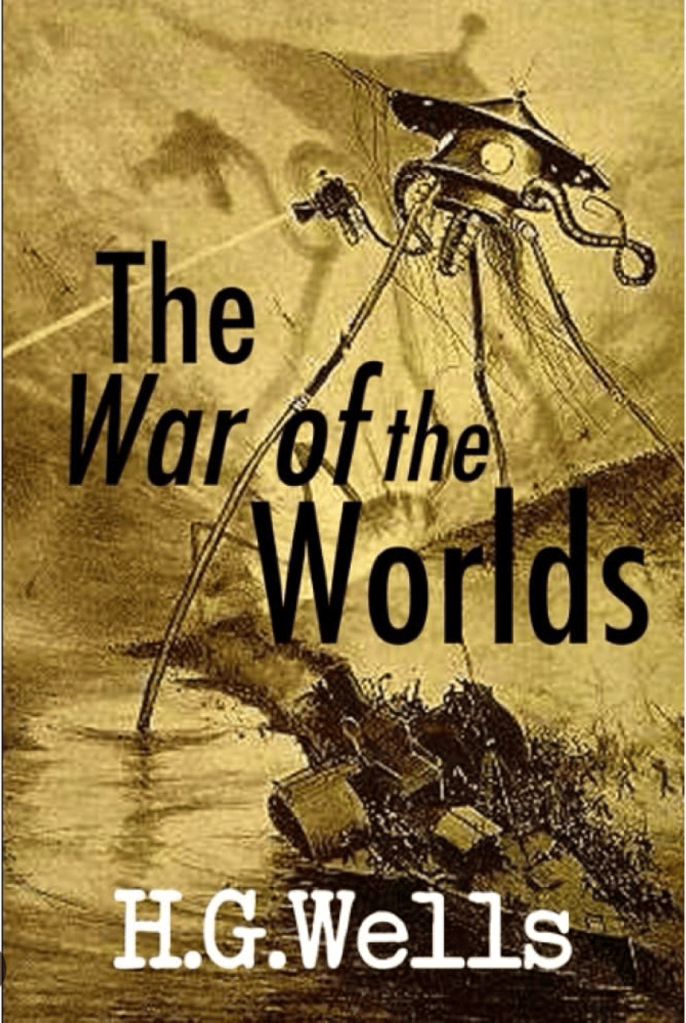
The War of the Worlds, by H.G. Wells
This is the book that invented the “alien invasion” trope which remained omnipresent in science fiction (and, increasingly, in pop culture in general) for twelve decades and counting. It was first published in 1898 and I don’t think it has ever gone out of print.
The plot is simple and as familiar as any fairy tale: Martians invade Earth, landing in the London suburbs and brushing aside the world’s mightiest military power with contemptuous ease. British society shatters under the shock as the tentacled Martians drive their tripod Fighting-Machines into the heart of London.
Our protagonist, a never-named author who is pretty blatantly H.G. Wells, first is curious about the new arrivals, then flees the chaos, trying desperately to find his wife. When she is reported dead he gives in to despair and ultimately wanders into the heart of alien London, only to witness humanity’s unexpected deliverance.
A section in the middle is told from the viewpoint of the narrator’s brother, as he and millions of others evacuate London ahead of the Martians, finally getting aboard a steamer to France. They witness the book’s one great human victory as the ironclad Thunderchild teaches the Martians that they need to learn a few things about sea power.
Influence: This is the book that started it all. One can literally describe all 20th-century science fiction as “War of the Worlds fanfic.” It has been adapted into almost every medium — most famously as a radio play by Orson Welles, but also at least five motion pictures, a TV series, a couple of video games, and about a dozen literary sequels and pastiches.
I can identify at least three science fiction subgenres which trace directly to The War of the Worlds: the alien-invasion story, of course; also the post-apocalypse story; and finally the whole category of military science fiction. Without The War of the Worlds we would not have Starship Troopers or Footfall or The Road Warrior. Unquestionably it deserves an A+.
Literary Quality: When he was being a novelist rather than a social critic, Wells was a great writer. The War of the Worlds shows why: he intended an allegory about how it might feel for Britain to be on the receiving end of some brutal imperialism, but at no point in the novel does any character turn to another and say, “this is just like what happened to the Tasmanians.” (There is an analogy drawn to the extinction of the dodos.) Wells’s characters are too busy fleeing and surviving. His picture of how people respond to catastrophe is very strong; while the narrator himself is kind of a blank viewpoint for the reader, all the minor characters he encounters are brilliantly sketched. This definitely rates an A.
Originality: While there were a handful of novels in the 1890s about dastardly foreigners invading Great Britain (intended as warnings about the need for military funding), and a handful of novels dating back to Voltaire about visitors from space, The War of the Worlds was a genuinely new idea: the alien invasion. It has become a standard trope. Wells’s treatment of the results of the invasion are also pretty original. Instead of giving us stiff-upper-lip officers drawing lines on maps and brave lads manning the guns, he shows us the frightened and confused civilians who only know that they need to get away from the Martians in order to survive. Definitely A+ for originality.
Science Fiction Quality: For a book almost 130 years old, The War of the Worlds holds up amazingly well as science fiction. Rocketry pioneers like Goddard and Tsiolkovsky were still just writing theoretical papers, so Wells had to have his Martians use a big cannon to launch themselves from planet to planet, but otherwise it’s all as plausible now as it was in 1898. He predicted directed-energy weapons and chemical warfare, and the way that fast mechanized combat would completely overwhelm 19th-century tactics.
The Martians themselves are marvelously plausible aliens. As far as I know, before Wells, alien beings were either just straight-up “men from other planets” or they were mythological beings like giants or angels. Wellsian Martians (and his Selenites in The First Men in the Moon) were extremely nonhuman, both in form and thought.
Even one of the big “plot holes” people like to jump on really isn’t. Wells makes it clear that the Martians have had a very advanced civilization for a very long time — possibly millions of years. Disease has been unknown on Mars since before humanity even evolved. It’s not that they never learned about infectious diseases, they’ve simply forgotten about them.
So as science fiction, The War of the Worlds definitely deserves an A+ grade.
Overall: Summing up the ratings, The War of the Worlds comes in just a hair under A+, and following the standard practice we round up, so it gets a full A+ rating.
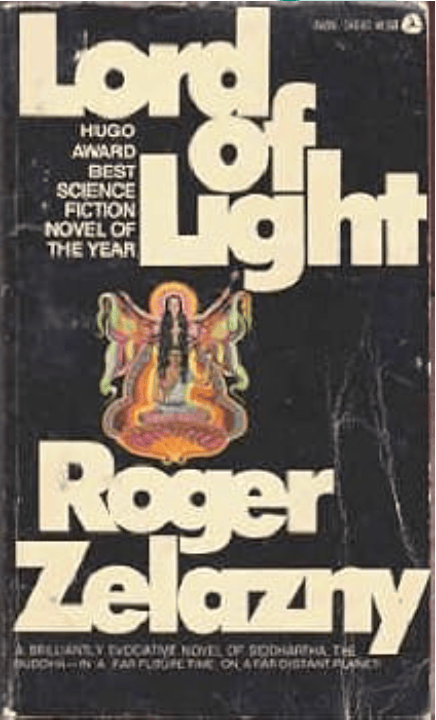
Lord of Light, by Roger Zelazny
This is a strange and fascinating book, which people seem to either love or hate. It tells the story of a man named Sam — or Kalkin, or Maitreya, or Mahasamatman — who is one of the crew of a starship (relativistic, I think) called the Star of India, which brought primarily South Asian colonists to a distant planet. Somehow the crew gained paranormal abilities, which came in handy when they had to battle hostile partly-material beings on the planet. Unfortunately, they then decided to set themselves up as divine rulers, taking on the names of the Hindu gods and keeping the planet in a state of preindustrial poverty. Sam becomes disgusted by this arrangement and begins a revolt, opposing the power of the gods by taking on the role of the Buddha.
The plot is too complex for me to summarize here. Suffice to say we see battles with zombie armies, death and reincarnation, demonic possession, nuclear weapons, and the most staggering pun in the history of science fiction (if you know, you know). In the end, the gods are not dethroned, but their power is diminished and it appears the humans will be able to develop a more advanced society.
Influence: Every science fiction writer I’ve ever met (except Brian Staveley) has cited Zelazny’s work as an influence. And certainly Lord of Light has remained popular in the sixty years since it first appeared. It won the Hugo in 1968 and was nominated for the Nebula, but did not win. It remains in print to this day. Remarkably, its biggest influence outside the science fiction community may have been the bit part it played in the operation to extract American embassy officials from Teheran in the early years of the Iranian revolution. As chronicled in the film Argo, the storyboards by Jack Kirby for a never-made film adaptation of Lord of Light were used to provide convincing accessories for the fictional film crew scouting locations in Iran, which was the cover story for the extraction. I’m giving it a B+ for influence.
Literary Quality: Like just about everything by Zelazny, the literary quality of Lord of Light is extremely high. The events in the novel are told out of sequence, as if it’s a collection of myths rather than a single narrative. As always, Zelazny’s characters are complex and his language is gorgeous. I give it an A+.
Originality: This book is unlike almost anything else in science fiction — with the possible exception of Zelazny’s other novel Creatures of Light and Darkness. However, a lot of its originality is in how it deploys and reimagines some standard tropes. Psychic or technological “gods” ruling ignorant peasants pre-dates Zelazny’s book (the trope shows up in King Solomon’s Mines, among others), and the psychic/energy-being “demons” go back to “Doc” Smith if not H.P. Lovecraft. I don’t think it’s a coincidence somebody asked Jack Kirby to do concept art for a film version — Lord of Light is extremely Kirbyesque in feel (except that Zelazny was a better writer). I give this book an A- for originality, as it uses old materials in a startling new way.
Science Fiction Quality: Sadly, this category is definitely the weakest one. Zelazny himself said he wanted to keep the story ambiguous: is it fantasy or science fiction? The result, as I just said above, winds up with the realism level of a comic book. A really good comic book. Zelazny presents us with marvels but barely bothers to even hand-wave how they might happen. As SF, rather than literature, Lord of Light gets a B.
Overall: The final average comes in just below A-, but because I’m rounding up, A- is the final grade.
The Final Result
So now, the envelope please! Which of our twelve candidates gets the highest overall rating?
(Drumroll)
The War of the Worlds, by Herbert George Wells! Stop hitting on your seatmate and come down to the podium to take a bow, Mr. Wells! It’s as influential as 1984, as well-written as The Left Hand of Darkness, as original as Dune, and as pure science fiction it’s as good as Moon is a Harsh Mistress, and overall it just barely misses a perfect score.
You heard it here first: The War of the Worlds is The Greatest Science Fiction Novel, Ever.
Next time I’ll discuss some books that didn’t make my list of candidates, speculate about non-English originals, and see what we can learn from our search.
If you disagree with my final choice, feel free to thrash it out in the comments.


5 responses to “The Greatest Science Fiction Novel Ever (Part 6)”
Honestly I wasn’t expecting this result, yet it feels right. It has been argued in a different context (sports) that greatness is about the creation of an archetype: as Chuck Klosterman put it, “the first elite rendering of an entity still containing the core characteristics of its most modern version.” War of the Worlds fits the bill nicely (as does LotR for fantasy).
LikeLike
You’ve hit on something important, I think: WotW is to SF what LotR is to fantasy. The work which defined a genre.
LikeLike
Definitely a good candidate for the best SF Novel, however, Wells’ The Time Machine would be an equally good fit. Both novels were the archetypes for their own varieties of SF — the alien invasion and time travel fiction. The shadow of HG Wells falls over much of twentieth century SF. Many SF writers either followed his models or reacted against them or explored possibilities he hadn’t tackled.
Wells and his brother Frank were out on a walk and talking about the fate of Tasmanians at the hands of predatory Imperialists who exterminated them. Frank remarked what if creatures of another star came down and did that to us? Us meaning Europeans, of course. The dedication to The War of the Worlds reads: To My Brother Frank, My Rendering of His Idea.
LikeLike
I really enjoyed reading this, Jim. Now I have a few books I need to go back and read again (or for the first time, in the case of A Clockwork Orange). Sometimes the results of an approach like this seem very dependent on exactly how you set up the rating system, but in this case, I don’t think it matters – The War of the Worlds is
LikeLike
I clearly don’t know how to use this site, my comment got submitted before I was done writing it, and with a bizarre name to boot…
What I was trying to say was that in this case, I don’t think quibbles about the rating system or the individual grades would change the result. The War of the Worlds has a very strong case.
LikeLike