
This entry features a couple of “heavy hitters” in the science fiction world: Robert Heinlein and Frank Herbert, so it’s a bit longer than the others so far.
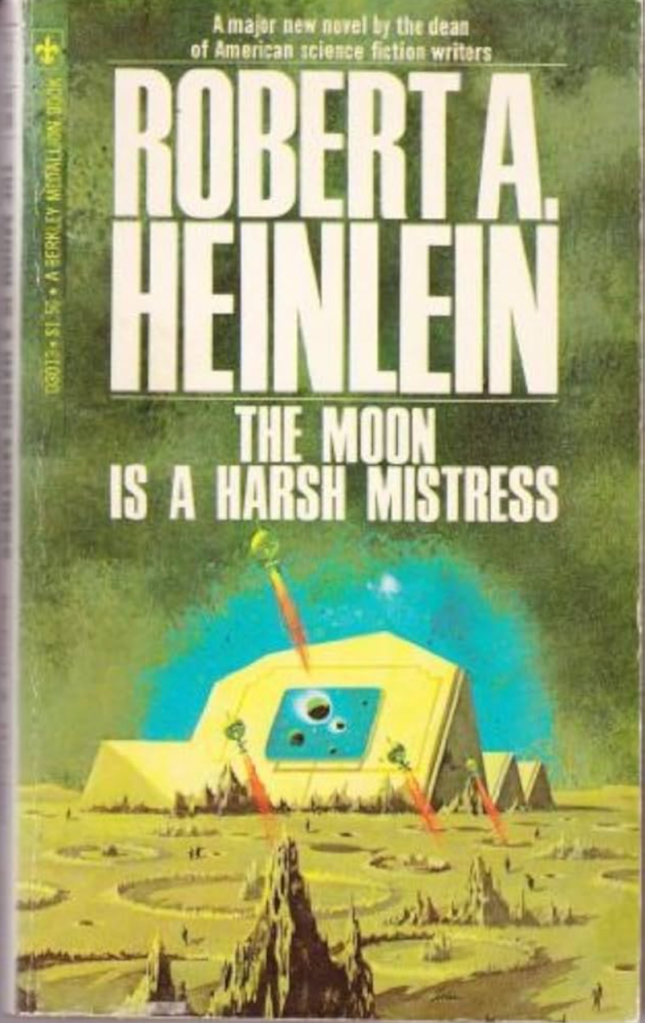
The Moon is a Harsh Mistress, by Robert Heinlein
I suppose I should start by explaining why this isn’t Starship Troopers. Two reasons: first, I tried to limit myself to one book per author, which meant a choice between Moon and Troopers. Second, while Starship Troopers is certainly influential — both inside SF and in the larger culture — I decided its other qualities just didn’t make the cut.
So: The Moon is a Harsh Mistress, like myself, first appeared in 1966. It depicts the birth of an independence movement in the penal colonies on the Moon in 2075, and their ultimately successful revolt against the Federated Nations of Earth. It won the Hugo and Nebula awards, and nearly two decades later was given the Prometheus Award for Libertarian fiction.
The mastermind of the revolution is an artificial intelligence, a supercomputer nicknamed “Mike,” which has spontaneously achieved self-awareness and free will, and has kept that fact a secret from the Lunar Authority which depends on it. Our narrator, Manuel Garcia O’Kelly, is the only human who knows about Mike, and treats it as a friend. Even with the brain of the colonial regime working for the rebels, the struggle for independence is not easily won. Heinlein includes a very good primer on conspiratorial cell structure, the use of propaganda, and how to hide a giant construction project in plain sight.
The society of the “Loonies” is often described as a template for Libertarian ideas of governance, but Heinlein is too shrewd to set up any kind of utopia. Before the revolution the Loonies are libertarian because they live under a completely tyrannical but lazy and inefficient regime — once they do achieve sovereignty those principles start to erode as the new republic has to grapple with the real issues of self-government.
Even nearly four decades after his death, Robert Heinlein still looms over the science fiction field. He’s like Louis Armstrong in jazz music: both of them simply defined their genre during their careers. Heinlein had some odd personal quirks — ideas about sexual liberation which seemed daringly transgressive and revolutionary in the 1970s now seem a bit icky (and there were others in the field at the time who were considerably ickier). He had some stinkers, there were books that felt kind of “phoned in,” but when he was passionate about a project he created some great science fiction.
Influence: As I mentioned, The Moon is a Harsh Mistress is practically a sacred text in Libertarian political circles. The Loonie motto “TANSTAAFL” (“There Aint No Such Thing As A Free Lunch”) crops up in political and economic discourse from time to time. The gritty, hardscrabble Moon colonies became the new standard for subsequent authors, and Heinlein’s idea of an electromagnetic Lunar cargo launcher pre-dates Gerard O’Neill’s concept of using Lunar resources to build structures in orbit. And the polygamous/polyandrous marriage structures of Loonie society have (for good or ill) influenced the polyamory movement. Strangely, no one has filmed it, though apparently it has been optioned a number of times. Definitely an A- for influence.
Literary Quality: Manny O’Kelly’s narrative voice is wonderful. Like Burgess (though not quite as deftly) Heinlein suggests a lot about the world just through the vocabulary his characters use. In this case, Earth is under Chinese hegemony, and the Loonies are a melting-pot of Russian, Australian, and dissident Chinese convicts shipped up from Earth. (A common thread in Heinlein’s novels of the period is a nuclear war between the United States and the Soviet Union which wrecks both powers, leaving China and India as the new top dogs.) The characters, especially Mike the computer, are well drawn. The plot is straightforward but believable. I give it a B+.
Originality: This book is just packed with new ideas. I already mentioned the lunar launcher, but Heinlein also scored a hit with his prediction of underground ice deposits on the Moon. This was all before the Apollo program, remember! The Lunar society is great. And no matter what you think of his ideas about sex and marriage, they were pretty novel in 1966. On the other hand, the space colony rebelling against Earth was a familiar trope in science fiction — Heinlein himself had already done it a couple of times. So I’ll give this a B+.
Science Fiction Quality: It’s excellent science fiction. The rationale for the revolution is based on the mathematics of resource depletion, the discussion of space war is masterfully done, and the Lunar secret weapon is simply the immense gravitational potential energy of the Moon’s position. The future society is plausibly extrapolated — would anyone bet real money against China being the dominant power in 2075? I give it an A+ for science fictionality.
Overall: Another A-. I hope this list doesn’t result in a tie. That’s always unsatisfying.
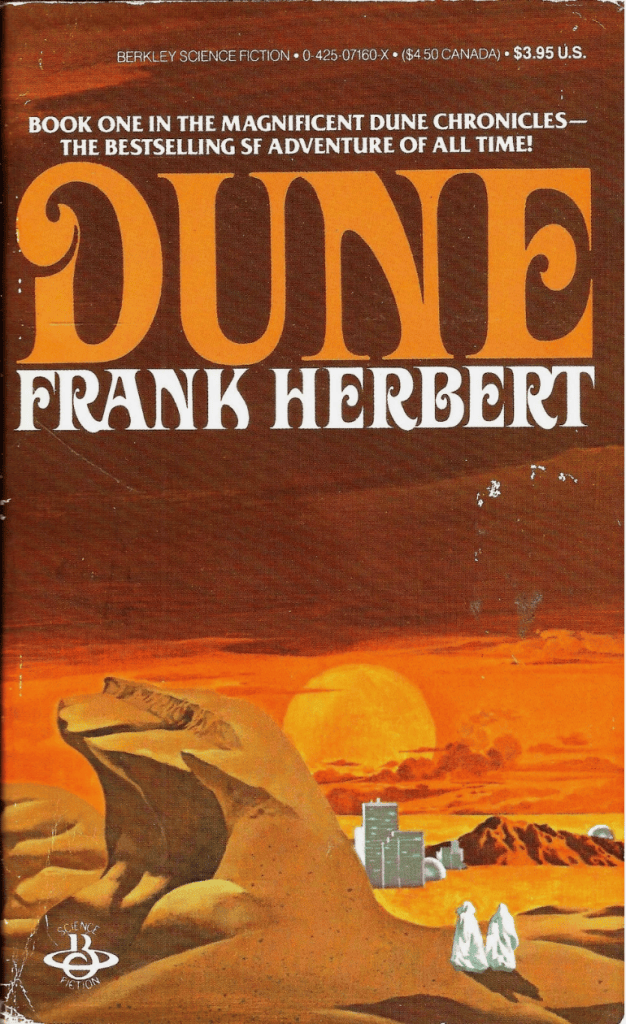
Dune, by Frank Herbert
Dune was kind of the inspiration for this series of posts. With the recent film adaptations by Denis Villeneuve, I notice Dune being routinely described as the greatest science fiction novel of all time and I started wondering if it really is.
The novel was first serialized in Analog in 1963-65, but I’m pretty sure Frank Herbert wrote it as a single work right from the start.
Book publication followed, but it was a strange path. In 1965 Chilton Books published Dune in hardcover. Chilton was not a science fiction publisher. Their primary product line was auto repair manuals, but their art director was Sterling Lanier, who was a fantasy and science fiction writer himself (his postapocalyptic science fantasy Hiero’s Journey was immortalized in Gary Gygax’s “Appendix N” in the original AD&D Dungeon Master’s Guide). He persuaded them to publish Dune. The Chilton edition wasn’t a success, but when Ace Books brought it out in paperback it became a huge hit. Dune won the 1965 Nebula award and shared the Hugo with Zelazny’s This Immortal (which is one of the more notoriously baffling Hugo results, up there with giving it to They’d Rather Be Right instead of Mission of Gravity in 1955).
I’m sure you all know what the book is about, so I’m going to keep my summary brief. Powerful Atreides family are awarded the fiefdom of Arrakis, source of the spice “melange” which prolongs life, makes interstellar travel possible, lets you see the future, and can be used as a floor wax and dessert topping. Despicable Harkonnens conspire with the Emperor to destroy the Atreides, but young Paul and his mother escape and take refuge with the Fremen, the descendants of the first settlers of Arrakis, now hunted by the Harkonnen forces. Paul eventually becomes a leader among the Fremen, leads a revolt against the Harkonnen overlords, takes the Imperial throne, and launches a war of conquest across the Galaxy.
Frank Herbert had a lot of experience as a newspaperman and political speechwriter, and one major influence on Dune was his experience covering land-reclamation efforts in the Oregon Dunes region. His background gave his depiction of the backroom political maneuverings in Dune a healthy dose of cynical realism.
Influence: Dune was (and remains) immensely influential both within SF and in American society and politics. The book’s depiction of the contrast between the exploitative methods of the Harkonnen overlords ransacking Arrakis for its spice resources, and the Fremen ability to adapt to the world and become part of it made it a keystone of the emerging “ecology” movement in the late 1960s and 1970s. The mind-expanding powers of the spice in the book resonated with the drug culture of the period. Basically, every college student between about 1966 and 1980 had a paperback copy of Dune, which probably smelled faintly of weed. It has inspired three film adaptations so far, along with the legendary never-made version by Alexander Jodorowsky. The book spawned numerous sequels by Frank Herbert and then by his son. It’s not just a book any more, it’s a “franchise.” For many people it’s their only exposure to science fiction. Definitely A+ for influence.
Literary Quality: Frank Herbert was definitely aiming for a greater degree of literary sophistication than many of his SF contemporaries. The characters are often unaware of their unconscious motives, or are trapped in roles they despise but cannot abandon. Paul’s developing psychic powers increasingly come to dominate his actions, making him almost an observer in his own story. However, Herbert has a few writing tics which are sometimes jarring: his inability to stick with a single viewpoint character in a scene, Baron Harkonnen’s over-the-top Ming of Mongo villain monologues, and an over-reliance on italicized internal thoughts. That knocks it down to A- in my estimation.
Originality: One reason for Dune‘s success was how different it was from anything SF had seen before. Sure, there were interstellar empires, but the one in Dune actually worked like a historical mercantilist empire. There were psychic supermen, but they were always power fantasies, while Dune showed Paul struggling against the power fantasy because he could see what it would cost. And the depiction of Arrakis’s harsh environment was very different from a lot of other SF, which tended to treat planets as puzzles to be solved rather than places to adapt to. Definitely A+.
Science Fiction Quality: Dune was the first SF novel I know of to focus on ecology — the actual science, that is — and Frank Herbert did a very solid job of imagining and depicting Arrakis’s environment and the way it shapes the lives of the people who live there. The novel has only two pieces of speculative science in it, and they are integral the whole story, not just window-dressing. Psychic powers are the big one: brains fueled by the spice can see the future, fold space to travel faster than light, and dominate others. The other is the force shield, which means all warfare is literally conducted by knife fighting. I think Herbert did a better job of working out the implications of psi powers better than he did with the shields. It’s notable that discussions of the Dune universe among SF fans often break down into “why didn’t they . . . ?” questions about shields. This is probably the greatest example. I give Dune an A as science fiction.
Overall: Dune clocks in as a high A, but not quite an A+.


3 responses to “The Greatest Science Fiction Novel Ever (Part 3)”
I can understand if the internal thoughts of Dune aren’t your “thing”, but should that really knock it down? It kept us connected to the characters, kept the book length reasonable as exposition of said thoughts would have blown up the word count and finally, was something different.
Dune definitely gets an A+ from me.
As long as you treat it as a standalone 😄
LikeLike
Dune… I know people are passionate about it, and I personally enjoyed the beauty of the Villeneuve movies. My comments will be in a minority here. Yet the book never really connected for me. On first read I found it depressing and honestly a bit boring. None of the characters were relatable. I suppose it could still be the Greatest SF Novel Ever, in the same way that kale might be the best vegetable. (Look at all that iron and vitamins! You gotta love it!)
LikeLike
Given your criteria, I can see rating Moon above Double Star for Heinlein. It’s more influential — both in and out of the community — but Double Star is better written and tighter.
As for Dune:
(Side comment — They’d Rather Be Right won in 1955, and was published in 1964. Mission of Gravity was published in 1953, and would have been eligible for the Hugo in 1954 — but none were awarded that year.)
To get back to the main thread. A lot of Dune is pulling out older tropes, and I’m more likely to downgrade it under your rules. The Influence rating is fine — it was that high. And while I find Herbert’s tics annoying enough that I call it B+, your A- is certainly reasonable.
But we’ve had mercantalist empires around lince Anderson’s first Van Rijn story in the 50s. And Smith’s Arisians (with better psychic powers) gave up control of the universe voluntarily in the 50s. And people adapting to their environment — with much greater adaptations — since certainly no later than Blish did in the stories collected in The Seedling Stars in the 50s. And Smith’s Lensmen — who could throw antimatter planets as destructive weapons — sometimes used axes for personal combat.
so, for me, it’s a solid B+/A- story — the influence rating helps keep it in the running.
LikeLike