
My first post in this series generated a satisfying amount of comments and response, so I’m pushing ahead. Here are the next two entries.

A Clockwork Orange, by Anthony Burgess
Anthony Burgess was a literary and intellectual giant, the author of novels, screenplays, reviews, essays, poems, translations, opera librettos, and music. He won the Nobel Prize for Literature in 1973. His career began in 1956 and he was a prolific writer until his death in 1993. (My favorite Burgess story is that when he and Jorge Luis Borges first met in person, the two of them conversed in Old Anglo-Saxon to prevent Argentine police spies from eavesdropping.) A Clockwork Orange tells the story of a young British gang member named Alec, who is subjected to an experimental treatment using drugs and conditioning to make it impossible for him to behave violently. As you might expect, a young tough who has harmed a lot of people and suddenly can’t lift a finger to protect himself is in for a whole lot of comeuppance.
When the book was published in the United States the final chapter was deleted, radically changing the tone and message of the story. In the cut version (which was the basis for Stanley Kubrick’s magnificent 1971 film) the story ends once Alec’s conditioning is reversed as part of a cynical ploy by political leaders to distance themselves from a controversial program, leaving Alec his sociopathic old self again. In Burgess’s final chapter we see an older Alec who is beginning to grow out of his violent, destructive ways. Minus that chapter the novel (and thus the film) are utterly black and misanthropic — everyone is corrupt and evil in various ways. With Burgess’s original ending we see that grace and redemption are possible.
Influence: No doubt due to the extraordinary Kubrick film, A Clockwork Orange is very widely known both inside and outside of the science fiction field. It still gets referenced from time to time in discussions of criminal justice, punishment vs. rehabilitation, and social decline. One can see its DNA in some of the cyberpunk fiction a generation later, depicting violent crooks as still somehow morally better than corrupt and hypocritical authorities. Letter grade B for this.
Literary Quality: It’s an extraordinary book. Burgess does what too many SF writers fail at — he suggests an entire world without ever coming out and telling the reader things. The teen slang is based on Russian, giving us a sense of future political and military shifts. It’s so well-written it has been given the standard backhanded compliment: that it’s “not really science fiction.” A+
Originality: Dystopian futures have a long pedigree. The idea of crime prevention through psychological conditioning goes back to the 1930s if not before (in the pulps, Doc Savage famously “cured” crooks through brain surgery). Alarmingly, most of them presented it as a swell idea. Burgess was not even the first to consider how horrifying the concept really is, as C.S. Lewis touched on it in his That Hideous Strength. So I’m afraid this book is a masterful reworking of concepts which were already floating around. B for this category.
Science Fiction Quality: It really is top-notch science fiction. There’s one new technology, the extremely plausible and well-thought-out conditioning process. There’s a society depicted which would be inclined to use such methods. And the characters inhabit their world completely. This gets an A.
Overall: The average score is A-, which does point to a potential problem ahead: if too many books come out with the same rating, how can I pick a winner? Suggestions welcome.
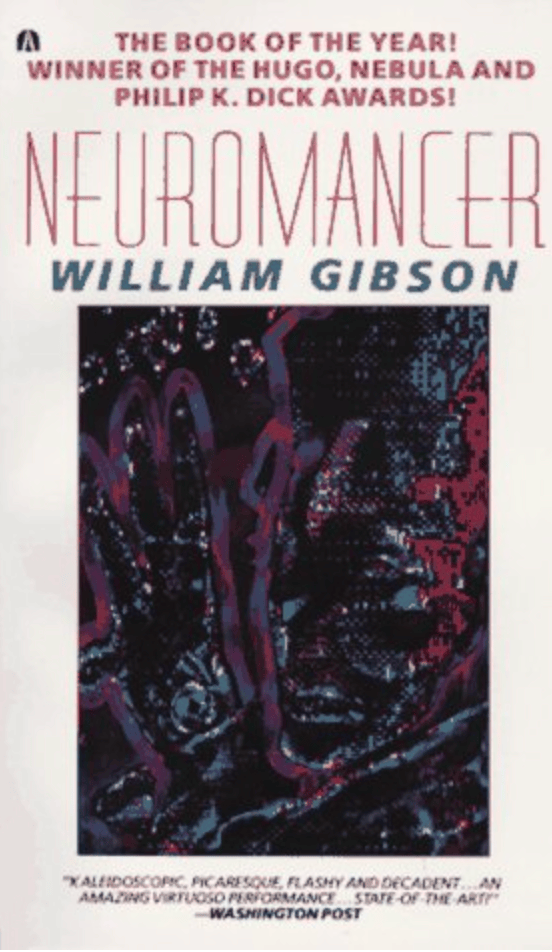
Neuromancer, by William Gibson
This book blew me away when I read it in 1984. It blew a lot of other people away, as well. It won the Hugo, Nebula, and Philip K. Dick awards, among numerous others. Along with the manga Akira and the film Blade Runner, it’s considered one of the seminal works of the cyberpunk subgenre, and arguably changed the way all science fiction was written thereafter.
The plot is a pretty straightforward heist story, set in a never-quite-defined year in the 21st century. The main character is Case, a “decker” (i.e. a computer hacker) who is recruited by a mysterious and possibly insane military man called Armitage as part of a team to break into the Villa Straylight, the headquarters of the fantastically wealthy Tessier-Ashpool family in their orbiting O’Neill space colony. There are “side quests” to get particular resources and recruit team members needed for the mission, and of course everyone has a hidden agenda and as the job goes down there are betrayals and counter-betrayals, in the course of which we learn the true purpose of the whole operation.
Neuromancer was immediately optioned for film, and has spent the past forty years in “development hell.” Finally AppleTV announced a streaming series adaptation scheduled for release in 2027. The irony of Neuromancer being owned and brought to the screen by a giant technology and media company not too dissimilar to the “zaibatsus” of Gibson’s future is perfect.
Influence: I think this may be the most influential single novel of the past century. No kidding. The technologists of the 1980s read Gibson’s novel and were captivated by his vision of the future, and much of the digital world we now live in was created in response to that vision. Terms like “cyberspace” from Gibson’s book are now everyday vocabulary. Meanwhile, every science fiction novel written after 1990 had to come to terms with the Gibsonian future one way or another. A+.
Literary Quality: Strong. From its classic (if somewhat obsolete) opening line, the book’s prose is amazing, and much is hinted rather than said. At times it’s almost like a poem than a novel, stripped down to the leanest possible text. That said, the characters are all more or less stock players and the “firehose of specific detail” style is used to keep the reader from thinking about the plot too much. I think it gets a B+ in this category.
Originality: From one perspective, there’s little actual new in Neuromancer. It’s got computer networks, artificial intelligence, cyborgs, domed cities, space colonies, and genetic engineering — all topics with decades of history in science fiction before William Gibson started typing this novel on a manual typewriter. But . . . only Samuel R. Delany ever looked at those components of The Future with the same viewpoint of “how will rebels, outcasts, and the underclass use these things?” Much of the appeal of Gibson’s book came from its new approach and the way it turned familiar tropes into something exciting and different, so I’m giving it an A.
Science Fiction Quality: Above average. Gibson did his research and extrapolated pretty shrewdly from the technology of the 1980s to what a “wired world” would look like. I would say the only flaw is that in many ways he wound up being too conservative. The technology of his cyberspace deckers, reliant on physical landline connections and all managed through virtual-reality interfaces looks almost quaint to modern understanding. Some of the science of cyberspace is a bit rubbery, too. At times it almost seems as if deckers become disembodied spirits outside of their bodies. For that reason the book gets a B+ — solid but not exceptional.
Overall: Neuromancer‘s average grade is A-, which seems about right for a genre-defining first novel.
Note: when I was searching for an image of Neuromancer to illustrate this section I was struck by how universally awful all the covers of the various editions are. How come such a great book gets such crap art and design?


One response to “The Greatest Science Fiction Novel Ever (Part 2)”
[…] That’s enough for Part 1. We’ll see how some of the others stack up in my next post. […]
LikeLike