
If you ask someone to name the greatest Fantasy novel, you’ve got a very good chance of hearing them say, “The Lord of the Rings, of course.” It’s a pretty safe bet. The Lord of the Rings was named the Greatest Novel of the 20th century — overall, no genre specified — in a British poll in 2000.
But if you ask what’s the greatest Science Fiction novel, it’s a lot harder to predict the answer. Much depends on the age of the person you’re asking, the kind of SF they like, how big an SF nerd they are, and probably what direction the wind is blowing at the time.
I think we should settle this.
Criteria:
1. I am going to limit this to English-language SF published since 1818, the year Frankenstein came out. I don’t want this to devolve into a brawl about what was the first science fiction novel, so we’ll go with a fairly well-accepted candidate and move on.
The English-only requirement does rule out some arguably great works, but I’m trying to avoid having to deal with judging translations vs. originals. Not a lot of individuals can read Jules Verne, Stanislaw Lem, the Strugatsky brothers, and Haruki Murakami all in their original languages, and some of those authors have better translators than others.
I am also excluding books published since 2020, as I don’t think six years is enough time to gauge a work’s influence.
2. The Greatest Science Fiction Novel (hereafter GSFN) should be reasonably popular. Not necessarily a best-seller, but a long-running favorite is a strong indicator. Otherwise we run into the philosophical question of “can a book be great if nobody reads it?”
3. It should genuinely be science fiction, by which I mean a story involving relatively realistic extrapolations of possible technologies, future societies, alien environments, and their effects. I will reluctantly accept “psionics” even though I personally think that’s just magic in a lab coat.
4. It should also be a good novel. Something you wouldn’t be ashamed to show your high-school English teacher. This rules out a lot of nostalgic fan favorites, which are beloved despite their failings as literature.
(Note that this puts a barrier — but not an insuperable one — in front of a lot of SF novels which began as “fixups” of multiple short stories and novellas into a single long work for book publication. Some of those were conceived as one story to begin with, then broken into chunks for magazine sale, so they work fine as a novel once reassembled, but others are just anthologies with chapter headings instead of story titles.)
5. I am not considering my own work. If anyone wants to argue that A Darkling Sea or The Godel Operation is the greatest SF novel ever, by all means make your case in the comments.
Here are my candidates, listed alphabetically by author:
The Player of Games, by Iain Banks
A Clockwork Orange, by Anthony Burgess
Neuromancer, by William Gibson
The Moon is a Harsh Mistress, by Robert Heinlein
Dune, by Frank Herbert
Brave New World, by Aldous Huxley
The Left Hand of Darkness, by Ursula K. LeGuin
1984, by George Orwell
Hyperion, by Dan Simmons
Snow Crash, by Neal Stephenson
The War of the Worlds, by H.G. Wells
Lord of Light, by Roger Zelazny
In the course of drawing up this list I checked over a variety of online “Best SF Books” lists and found them all annoyingly similar and unsatisfying. They all seem to include many of the works I list here — and then a bunch of stuff that just came out the year the list was published. It reminds me of an American Film Institute list of the 100 Greatest Films of All Time I saw in 1994, which proudly listed the Arnold Schwartzenegger action comedy True Lies (1994) as one of them. That film dropped considerably in the rankings by the time the next list came out. So these are the candidates.
So which one of those is The Greatest? How to pick the best of the best? I’ll discuss each one briefly, and rate them on influence, literary quality, originality, and science fiction quality. I will use letter grades for each.
The Player of Games, by Iain M. Banks
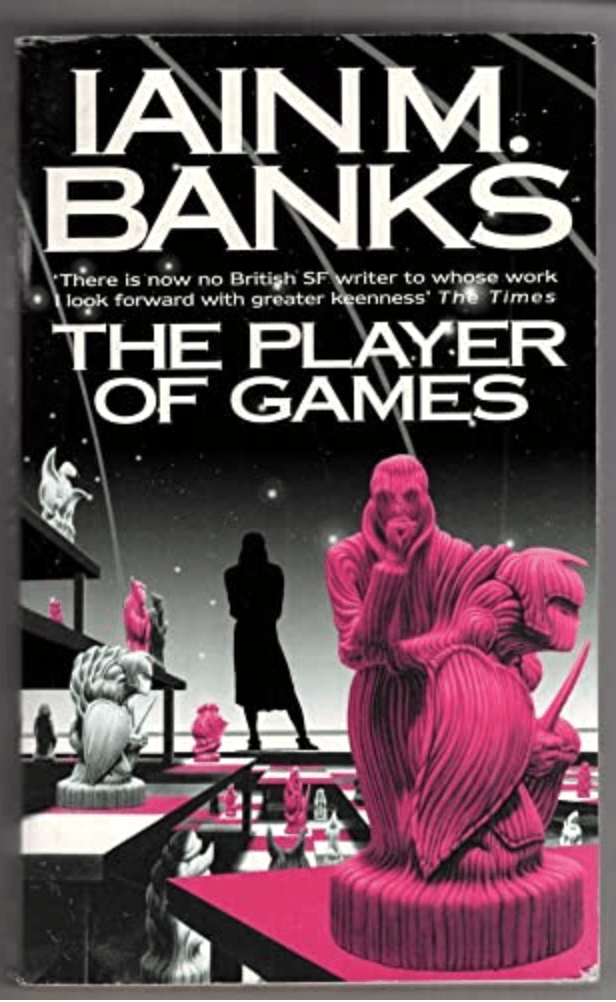
This is one of Banks’s novels involving the multi-species interstellar civilization known as “the Culture.” It first appeared in 1988. The story follows an expert game-player, Gurgeh, who is recruited/blackmailed into taking on a mission for the Culture’s foreign affairs/covert operations section, known as Special Circumstances. He voyages to the Lesser Magellanic Cloud, the home of the Empire of Azad, an oppressive society that the Culture wants to dismantle. As it happens, the Empire chooses its leaders by their proficiency at a vastly complex wargame called Azad. All Gurgeh needs to do is win — and not get killed by the Azadi, who are understandably annoyed at the idea of some foreigner waltzing in and beating all of them at the national game.
Influence: Banks’s Culture series as a whole was very influential, and this book in particular is still ranked in the top 100 space opera bestsellers on Amazon, nearly 40 years after publication. However, it has not spilled over from print into other media. I’ll give it an A- in this category.
Literary Quality: Strong. Banks is an excellent writer and tackles complex themes. The Player of Games gets an A for this.
Originality: Above average. The idea of a society obsessed with a particular game has a history in SF dating back to Edgar Rice Burroughs’s Martian game of Jetan, if not earlier, and we’ve seen our share of lone agents taking on empires before. I’ll give it a B+ in this category.
Science Fiction Quality: Again, above average. There’s some solid speculation about how a mixed human/AI civilization might work, and the society of Azad is decently drawn, but I am going to deduct points for Banks’s blatant “rubber forehead” humans pretending to be aliens. B.
Overall: The average falls between A- and B+, so I will be generous and give The Player of Games a final rating of A-.
That’s enough for Part 1. We’ll see how some of the others stack up in my next post.


5 responses to “The Greatest Science Fiction Novel Ever (Part 1)”
Submitted for your consideration: Vernor Vinge’s *A Fire Upon the Deep*.
LikeLike
Your fair but strict limits rule out some truly great books. Miéville’s *The City & the City* isn’t really SF; Miller’s A Canticle for Leibowitz* isn’t a novel; Crowley’s *Engine Summer* is enormously under-appreciated. Alas.
As for *Player of Games* I might have suggested *Consider Phlebas* instead, but maybe the best Culture book is the one you read first.
LikeLike
It is very hard to narrow it down to one title. But “Dune” and “Hyperion” are top of my list. I also feel that “A Fire Upon the Deep” and “Three Body Problem” are strong contenders (in my mind) although the latter is a translation so it might not fulfill the criteria here.
LikeLike
I nominate Stand on Zanzibar
LikeLike
I certainly agree that the Vinge belongs on the list. I’d also put Alastair Reynolds on the list, although, since you’re only listing one novel per author, I can’t decide between Revelation Space and The Perfect (that’s the original title — it’s now titled Aurora Rising)
I’d also pick a different Heinlein — I’d go with Double Star. It’s shorter, tighter, better written, and has one of the finest opening lines the field has ever seen.
You’re also missing some of the essential older novels that define Hard SF. So I’d include Hal Clement’s Mission of Gravity and Poul Anderson’s Tau Zeo. And, for scope of concept. I’d need to include Larry Niven’s Ringworld, and Niven/Pournelle Mote in God’s Eye.
And, since MilSF is often overlooked, I’d include Henry Kuttner/C.L.Moore’s Fury, and Gordon Dickson’s Dorsai.
But, in the end I’m still forced to choose Lord of Light. It breaks major rules they teach writers — it’s clearly SF, but reads like Fantasy, it has an unsignaled flashback, etc — but Zelazny pulled it off brilliantly. It shows what the field can produce when you have a literary genius at his best.
LikeLike