
My recent tour of Indochina made me think about travel and why we do it. I like to go places, and I grew up in a city that was becoming a major tourist destination, so I think I have at least some understanding of both sides.
What is “Travel” anyway? We spend time and money to go someplace that isn’t home. (For this discussion I will leave out travel to visit relatives and places that are or were “home” in some sense. Visiting Grandma or your grandchildren isn’t how most of us think of “Travel.”) So why travel at all? Isn’t home good enough?
Evidently not, as “Travel” is a trillion-dollar industry. Airlines, hotels, car rental agencies, theme parks, resorts, tour companies, casinos, and cruise lines are all big companies that exist because people like to travel. And for every billion-dollar company there are thousands of small and medium businesses which exist to serve travelers. Would New Orleans have 1800 restaurants (enough for literally the entire population of the city to dine out at the same time) without tourists? Would anyone at Artisans Angkor weave silk without visitors to sell to? Would Yankee Candle in Deerfield stay in business if it had to survive on just the market for scented candles in Franklin and Hampshire counties?
And yet . . . there are casinos everywhere nowadays. There are restaurants everywhere. There is a Yankee Candle store in almost every shopping mall. I can order silk goods delivered to my house with one click. By driving less than half an hour from my little New England farm town I can dine on Brazilian, Cambodian, Chinese, German, Greek, Indian, Irish, Italian, Japanese, Korean, Mexican, Middle-Eastern, Nigerian, Persian, Polish, Portuguese, Salvadoran, Thai, Turkish, or Vietnamese food — and that’s just what I can list off the top of my head. Why spend 30 hours on a plane?
Viewed from the perspective of a Martian anthropologist studying humans, recreational travel is weird. Many tourists go off on their trips from places which are destinations for other tourists. And you can’t just blame all this on the big companies in that trillion-dollar industry fooling us all into spending money — tourism existed in Pharaonic Egypt, three thousand years before J.W. Marriott was born.
I think the answer is simple, really. We crave new experiences. Diane and I went to Cambodia because I wanted to see Angkor Wat. Diane booked space for us on a hot air balloon flight over the Loire because neither of us had ever done that before, and we got to see architectural treasures in a lovely landscape from above. Even people who don’t go abroad still like to see new places within the United States — New York, the Grand Canyon, Walt Disney World, or Wall Drug Store in South Dakota.
We want variety — and we want authenticity. Sure, I can eat Italian food in Greenfield, Massachusetts, and it might be wonderful — but I still want to go eat Italian food in Rome or Venice or Spoleto. Reading about the Mayan pyramids of Yucatan is fascinating, but I want to see them with my own eyes.
But! There is a threat to tourism. I’ve been noticing it for decades and our visit to Indochina really confirmed it. What is the threat? Utopia. A world of peace and growing prosperity, with rapid commerce, affordable travel, global media, and few restrictions on who can go where. Since 2018 more than half the world’s people are middle class or wealthier.
All that prosperity and globalization means two things. First, more people than ever before can travel. The two main airports in Cambodia are huge, built to handle many more planes than they currently have to accomodate. But I’m sure the Cambodian leadership can read a graph: if the number of visitors goes up every year, you’d better be ready for them.
Countries can expand airports and roads, developers can build hotels, airlines can lay on extra flights — but it’s a lot harder to expand the things people actually go to see. A theme park may be able to add new sections as demand goes up, but that can’t happen at Angkor Wat, or Venice, or the Grand Canyon.
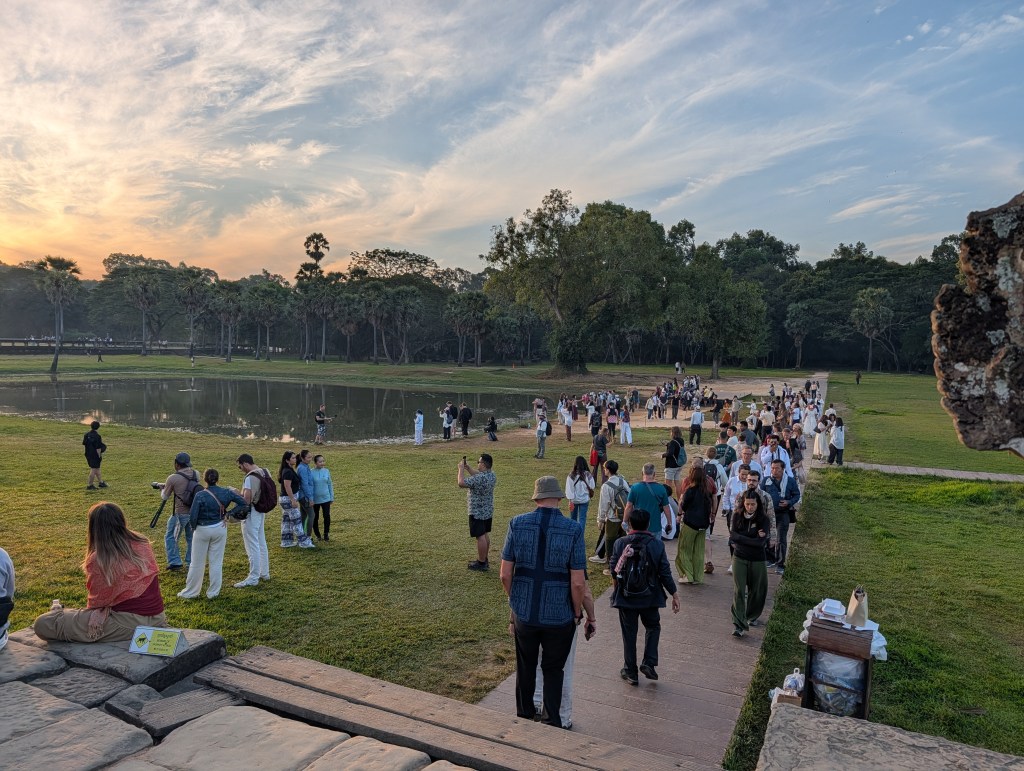
A photo of people taking photos of Angkor Wat.
We’re already seeing this kind of logistical bottleneck at various tourist destinations. At Angkor I watched people climbing up the single set of steep steps to reach the upper level of the temple: a constant stream going up and another constant stream going down, from dawn to dusk, every day the place is open. Two million people a year go up those stairs and back down again. I suppose the Cambodian park service could put up a second stairway, but at some point the sheer number of visitors becomes simply unmanageable.
One encounters the same problem all over the world: the Louvre — especially the gallery where the Mona Lisa is on display — is incredibly crowded. An art lover can’t stand and contemplate the collection because there are people behind pushing to get their look. Same at the Uffizi in Florence. Same at the Vatican. Same at the Tower of London.
Sacred sites in the Middle East take this to an even greater level. Depending on whether Israel’s neighbors are shooting at them, visitors to Jerusalem range from a million a year to four million. The annual pilgrimage to Mecca draws two million people all at the same time. An entire metropolis has grown up around Mecca to handle that influx.
Natural wonders like Yellowstone and the Alps have the same problem. Even Mount Everest, which nobody was able to climb before 1953, now gets hundreds of climbers a year, with a pre-COVID peak of nearly a thousand. Back in the 1990s Diane and I went on a dive trip to Roatan Island in Honduras, which at the time hosted maybe two or three dozen visitors at a time. Now there’s a cruise ship terminal at Roatan, and — unsurprisingly — the reef itself is in danger because of the great number of people coming to see it. I’m told Cozumel has the same issue. The Khao Yai mountains in Thailand are getting the first wave of commercialization, and how long will that region retain the very things that make it appealing?
The science fiction writer Larry Niven predicted some of this in a series of short stories about how cheap and convenient teleportation would affect society. In his future, “flash mobs” of thousands of people could show up anywhere in the world, motivated by what we would now call social media influencers. But it turns out you don’t need teleportation, you just need five billion middle-class people on Earth with enough cash and leisure time to go abroad on vacation.
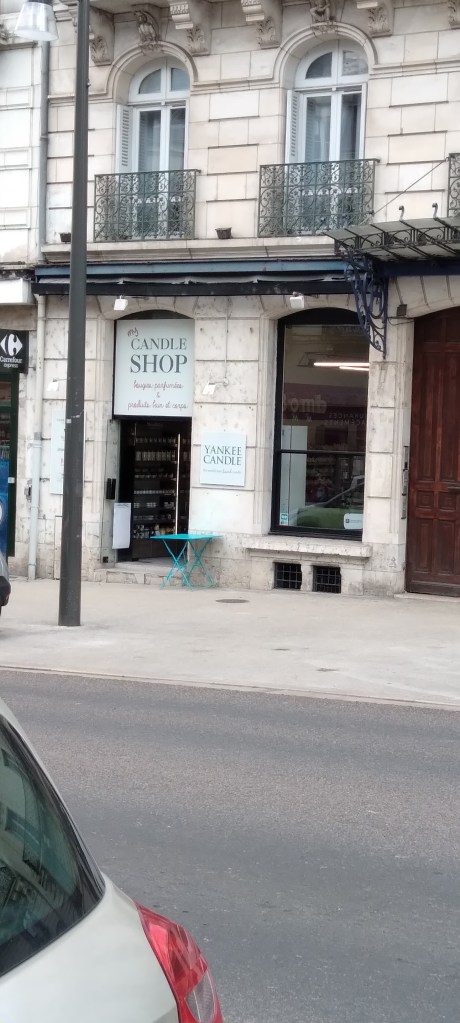
Yankee Candle shop in Blois, France.
The second problem created by prosperity is that we are truly becoming a global civilization. There are Starbuck’s in Phnom Penh, and a Hard Rock Café in Siem Reap. Cambodians zip around (slowly) on Honda scooters and on our road trip we passed a John Deere dealership selling equipment for rice farming.
It’s easy to decry this kind of homogenization but the simple fact is that humans aren’t very different. The same thing that made Starbuck’s a success across the United States made it a success across the world: coffee of predictably decent quality. People like that. Maybe in Cambodia some native-born coffee chain offering better coffee will crowd out the mermaid, or at least fight her to a draw the way PJ’s and CC’s did in New Orleans by catering to local tastes.
And the same desires that shaped “suburbia” in America have spread it to Europe and Asia. People want to own a home. People want to drive where they want, when they want. People want to shop at a well-scrubbed supermarket rather than at a colorful collection of stalls under a sheet metal roof.
What all this means is that places on different continents become indistinguishable. Why do tourists go to Manhattan rather than Islip, Long Island? Because Islip isn’t all that different from Quail Valley near Houston, or Echo Lake near Seattle — or Brétigny-sur-Orge near Paris, or Yotsukaido near Tokyo.
However . . . Manhattan increasingly isn’t all that different from Houston, or Seattle, or Paris, or Tokyo, either. Several years ago I was visiting New York City and walked down Broadway from the offices of Tor Books in the Flatiron Building on Madison Square, to my agent’s office a couple of blocks south of Houston Street.
When my parents were just married in the early 1960s, they visited New York several times. It was what you did, especially if you were from a Southern city. You could get things in New York that simply weren’t available in Texas or Louisiana. So on my promenade down Broadway I was expecting to see some unique New York shops selling things I couldn’t buy in western Massachusetts. And what did I see? McDonald’s, Starbuck’s, Subway, Nike, Panera, Barnes & Noble, Spirit Halloween, Staples, Carhartt . . . all the places I can find on Route 9 in Hadley, Massachusetts. Sure, I did stop in at the Strand Bookstore. But Hadley has Grey Matter Books, which is a rather good used bookstore. The Strand is nice, but I wouldn’t travel to New York City just to shop there.
Which brings us back to the question of why travel at all? If going to New York doesn’t let me see or do anything I can’t do at home, then why should I go there? And over time the same will apply to Paris, or Tokyo, or Bangkok. Prosperity and globalization are making tourism easier and more common . . . and simultaneously less satisfying and more pointless.
Next time I’ll discuss some possible remedies.
 The Cambias Digression