
What did I learn from visiting Cambodia and Thailand?
First, the world is a lot smaller than it was. In Phnom Penh there was a Starbucks a block away from our hotel. In Siem Reap there was a Hard Rock Cafe. We passed 7-11 stores and Chevron stations (“Caltex” but it’s the same company). My phone can now translate just about any text to English at the touch of a finger. In short, there’s no reason not to go anywhere you like. Unless it’s in the middle of a natural disaster or a war zone, it will probably be safe, comfortable, and fun. I will write about this at greater length in a later post, but in short: don’t worry so much.
A related lesson, which I learned years before this trip, is: there is no bad food. Humans are not that different from one another physically, so the things we eat are actually pretty similar. If people in another country eat something, it’s certainly edible, probably palatable, and likely pretty good. As I noted in the food tour of Bangkok episode, the dreaded durian fruit wound up tasting like . . . fruit. Nobody eats poison, so don’t be shy about trying local foods. If there are hygiene issues, that’s a legitimate concern, but I don’t think any intestinal parasites can survive immersion in a deep fryer, or grilling over open flames.
Another lesson, which is actually an old one. Pack lighter. The old rule of thumb is “bring half as many clothes and twice as much money.” When Jules Verne’s hero Phileas Fogg set out to go around the world in eighty days, he brought one bag with a couple of shirts and spare underwear — and twenty thousand British pounds sterling in cash. Make him your role model. You may not need to buy elephants and steamships, but money makes a lot of problems go away. On the Indochina Expedition we paid for hotel laundry service twice, and even with the mighty power of the U.S. dollar working in our favor, it still wasn’t cheap. Even in southeast Asia, labor-intensive jobs like laundry cost money. BUT: how much is it worth to have a smaller bag to drag around? Twenty bucks? Fifty bucks? That’s about how much laundry cost us.
Which points up a feature of this trip which is almost embarassing to discuss: the mighty power of the $USD. Exchange rates don’t matter as much as buying power. A Thai baht exchanges for about 3 Japanese yen, but prices in Thailand — for consumer goods and meals, anyway — were about half what they were in Massachusetts after conversion. And in Cambodia things were a third or less. I could buy a single 12-ounce Coke in a Phnom Penh shop for about 1000 riels, or 25 cents. At home, if I buy a twelve-pack at the supermarket when they’re on sale, I might be able to get close to that price, but buying a single bottle or can from a vending machine or a convenience store will cost more than a dollar (sometimes two or three dollars if you’re at an airport or a toll road service area).
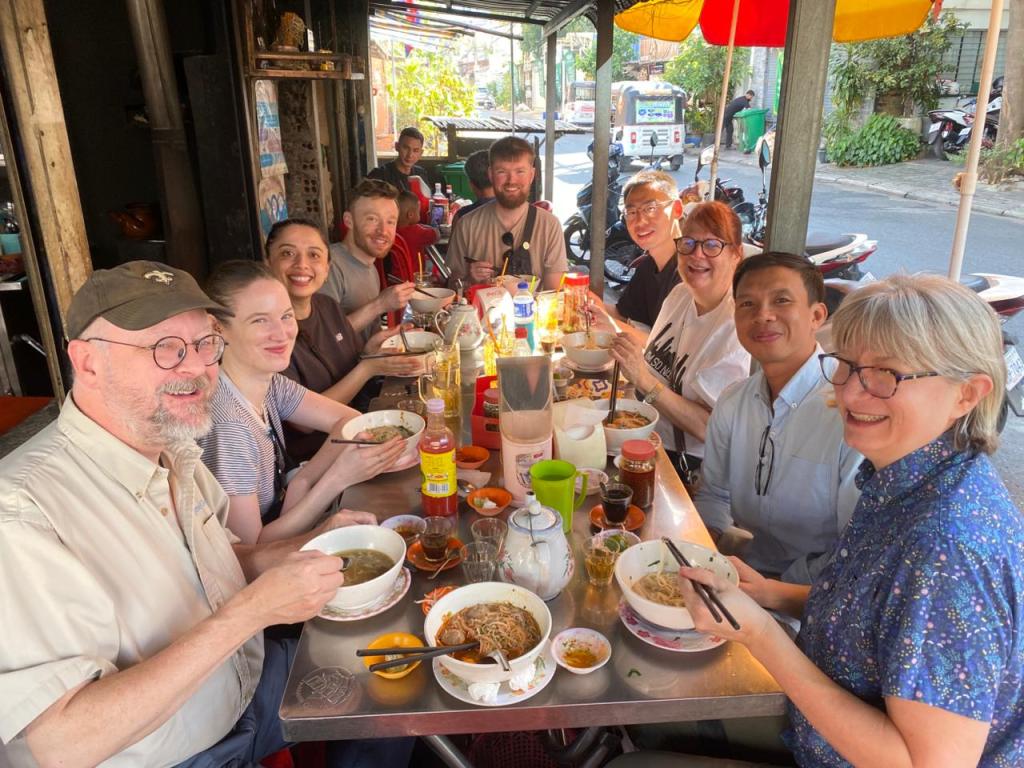
This journey was our first experience with tours, and overall I was satisfied. Both Dr. Kelly and I tend to fret over the details of reservations, travel arrangements, scheduling, etc., and it really was pleasant to let someone else deal with all that. My fears about being stuck in a bus with what my parents called “Fred and Maude” proved unfounded. In fact, I much preferred the group tour in Cambodia to our “private” tour in Thailand. Frankly, it was nice having more people to talk to.
However, the tours did make me feel a bit over-scheduled at times. Our day in Siem Reap after the end of the Lost Plate tour was very pleasant because we could see what we wanted to see and eat when we felt like it after a week of being hustled on and off of tuk-tuks according to a timetable. Even on the private tour, where we were in a better position to call the shots, there was always the sense that the meter was running, so we wound up being just as busy. I’m not sure how to reconcile those two issues.
Specifics for southeast Asia: bring your own paper towels or some big handkerchiefs. Bring bug repellent — I found some that comes in “stick” form like antiperspirant, a useful way to get around air travel restrictions on bottles of liquid. Hand sanitizer was also useful. Get international phone and data service for your cell phone. That’s essential nowadays: your airline assumes you can get text notifications about changes to your flight, and your phone serves as map and translator. Someday we will wonder how people managed to travel with paper maps and printed phrase books.
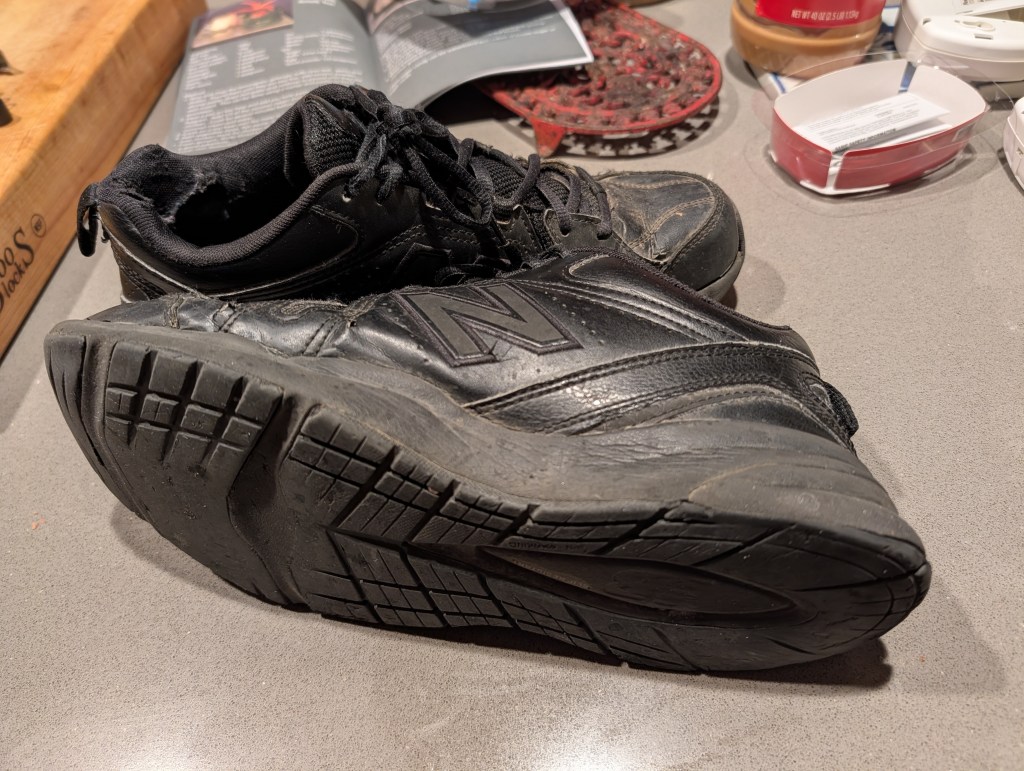
One casualty of the Indochina Expedition was my shoes. I wore those shoes in Prague, the Loire Valley, Iceland, Australia, and in Thailand and Cambodia — not to mention walks on the local rail trails, science fiction conventions, and trips to the gym. By the time we got home from Japan the treads were worn smooth, parts of the heels were peeling away, and the uppers were starting to separate from the sole. I alreay had replacements on hand before the Expedition, but I decided to get one more journey out of them before the end. R.I.P. My Black Sneakers.
 The Cambias Digression
One response to “The Great Indochina Expedition: Final Thoughts!”
[…] Next time: final thoughts. […]
LikeLike