
The next day we rose early and breakfasted on the hotel’s riverside terrace. We could hear music from the temple across the water, and Dr. Kelly spied on birds in the trees shading our table. I watched the boats on the river. The Chao Phraya carries a lot of traffic, and it’s interesting to see the differences between Thai barges and the ones I grew up watching on the Mississippi.
The most obvious difference is that the barges in Thailand are live-aboards. Each one has a little deckhouse at the stern, with all the signs of habitation: potted plants, chairs on the deck, kids playing (SOPI = 3). The barges go in trains of two or three, typically pulled by a small tug at the end of a surprisingly flimsy-looking line. One also sees barges riding very high, going upriver empty for another load. My suspicion is that since the heavy freight (sand and gravel, mostly) is going downstream with the current, the towboat’s main job is steering rather than propulsion. The fact that there was often a second towboat trailing behind the barges, unpowered, seems like supporting evidence. If any Thai barge pilots are reading this, please enlighten me.
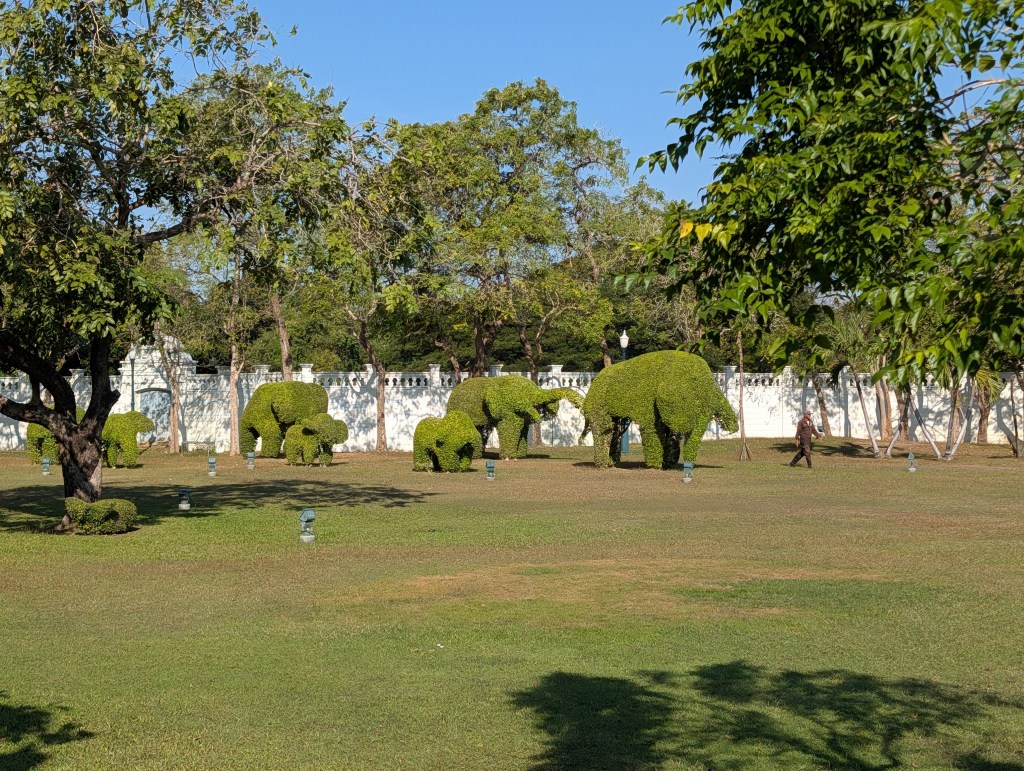
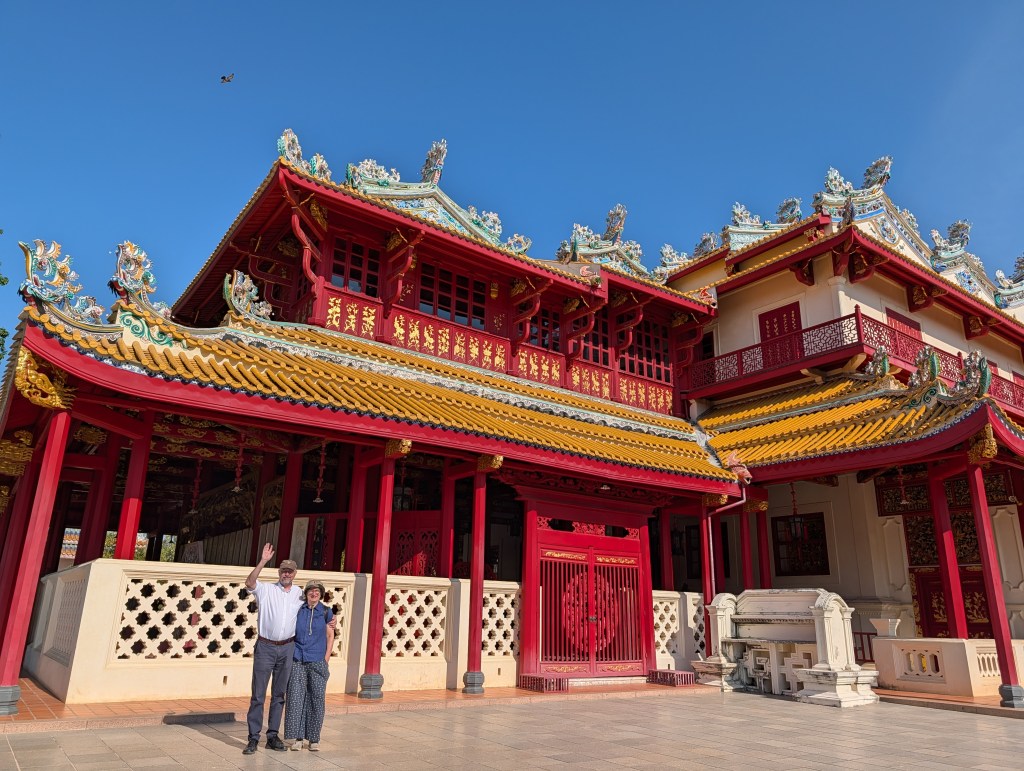
Our guide Sita collected us shortly afterward, and we all rode in the Party Van for a visit to the Royal Summer Palace just south of Ayutthaya at Bang Pa-In. Henri Mouhot had nothing to say about this place because most of it was built in the late 19th century. (In fact, other than griping about mosquitos and mentioning the price of chicken, he pretty much ignored Ayutthaya entirely.) It’s a lovely place, with lots of ornamental lakes and ponds, and various palaces and pavilions in a variety of styles. There’s a Chinese-inspired hall, a Baroque one that looks airlifted in from Versailles, and the main royal residence building — which looks like a comfortable French country house of the Belle Epoque. Around the edge of the compound are some large bungalows, which were apparently built for King Chulalongkorn’s wives. All in all, it looks like a swell retreat and if I were the ruler of Thailand that’s where I’d spend my time.
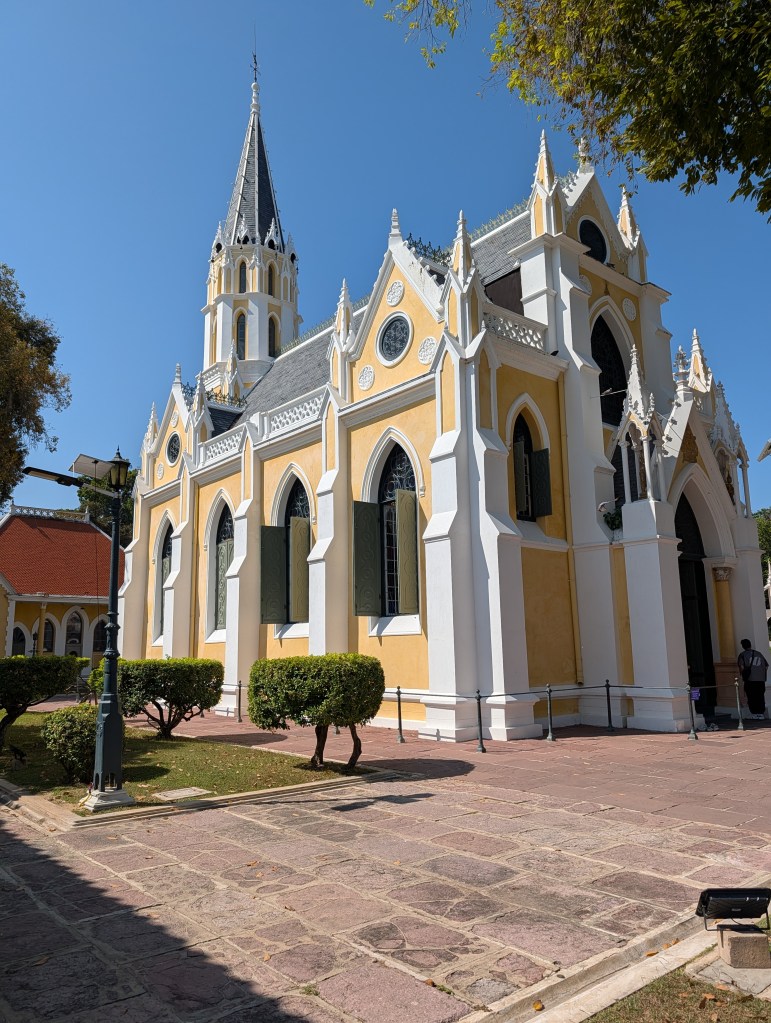
From there we rode a slightly rickety cable car across to a large island in the Chao Phraya river, to have a look at the remarkable Wat Niwet Thammaprawet temple. It was put up in 1878 and is entirely European in style. It’s basically a Victorian-era tropical colony church except for the fact that the altar has an image of the Buddha on it instead of Christ. There’s stained glass and everything. It’s really quite a charming spot, and is part of a larger monastery complex.
With that accomplished we drove back north to Ayutthaya, stopping along the way at Wat Yai Chai Mongkhon, a big temple just east of the old city. Unlike the temples in Ayutthaya proper, which have round-topped pagoda towers in the Khmer style (like Angkor Wat), the Wat Yai Chai Mongkhon is Thai-style, with a pointy-topped pagoda. The temple boasts a big reclining Buddha (thoughh not quite so big as the one in Bangkok). It’s still an active monastery, and our guide described how a great many people in Thailand spend some time as monks or nuns — some for years, some only for a few days every so often.
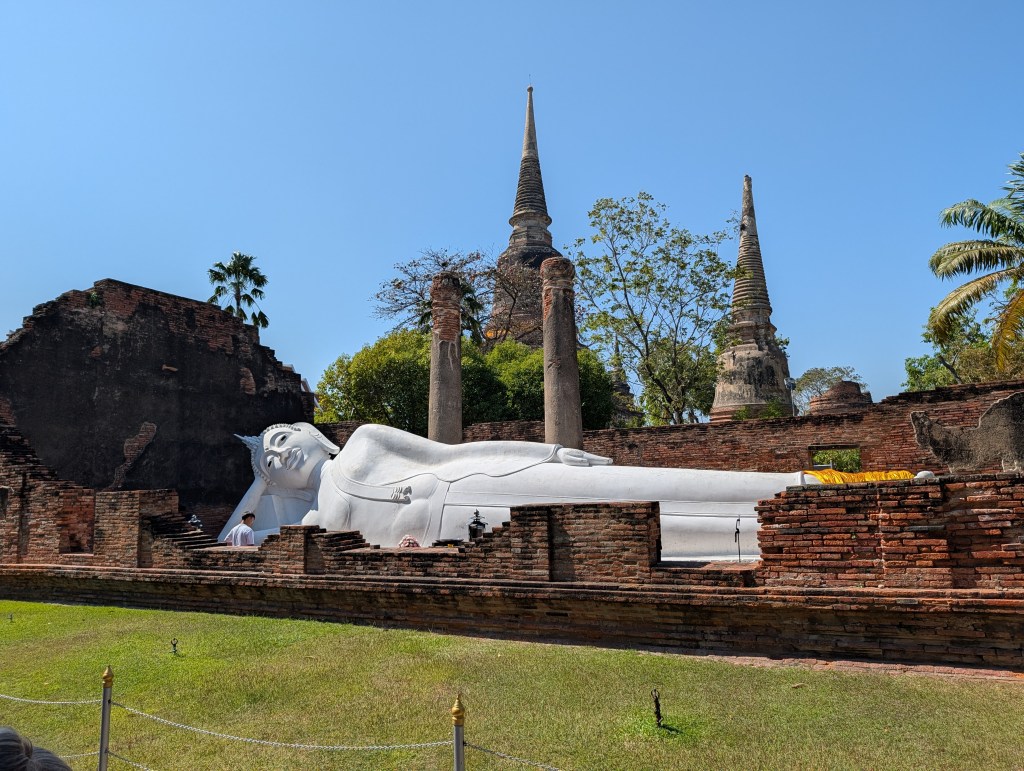
Like most old structures in or around Ayutthaya, Yai Chai Mongkhon got worked over by the Burmese in 1757, but the main pagoda was too big and massive for the invaders to really damage. Unfortunately there’s a more relentless enemy at work even now: the whole complex is fighting a losing battle against the elements. Thailand doesn’t have frost, and I don’t think this part of the country gets many earthquakes, but the simple fact is that massive structures of brick or stone built on squashy alluvial soil are going to subside over time. The foundations will sag, the blocks will crack, the towers will lean, and without constant maintenance and regular large-scale renovations, eventually time will win.
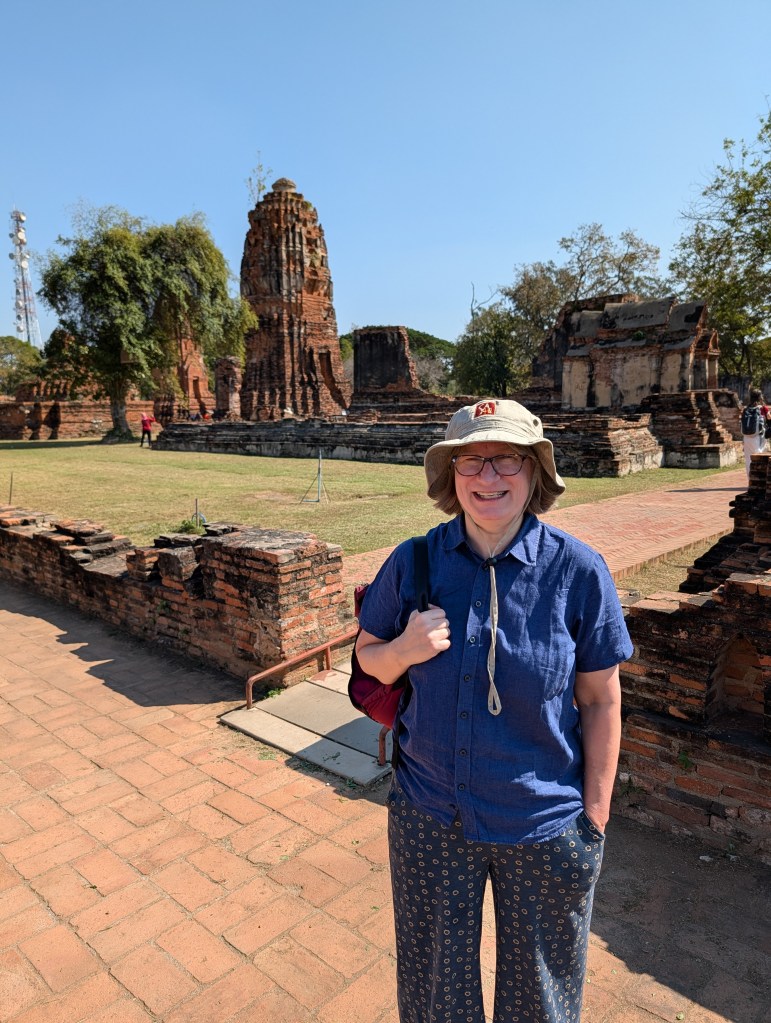
We lunched in Ayutthaya on noodles and a “fried salad” — which was kind of like Indian pakoras. Then one more big temple before our afternoon break. The ruins of Wat Mahathat are in the center of old Ayutthaya, and was once a massive pagoda 50 meters high. It partially collapsed in 1904, and then completely in 1911. The rubble has all been cleared away, leaving the stump of the great tower.
(I found a couple of good Web sites about Ayutthata only after we left. Links are here and here.)
We were both feeling a bit worn out so we bailed on seeing Traditional Handicrafts and spent the afternoon napping. Around sunset our guide Sita returned with a couple of tuk-tuks, and we tukked over to the Wat Chai Watthanaram temple, which stands on the Chao Phraya river bank across from the west side of Ayutthaya, and which we had admired from our lunch boat the day before.
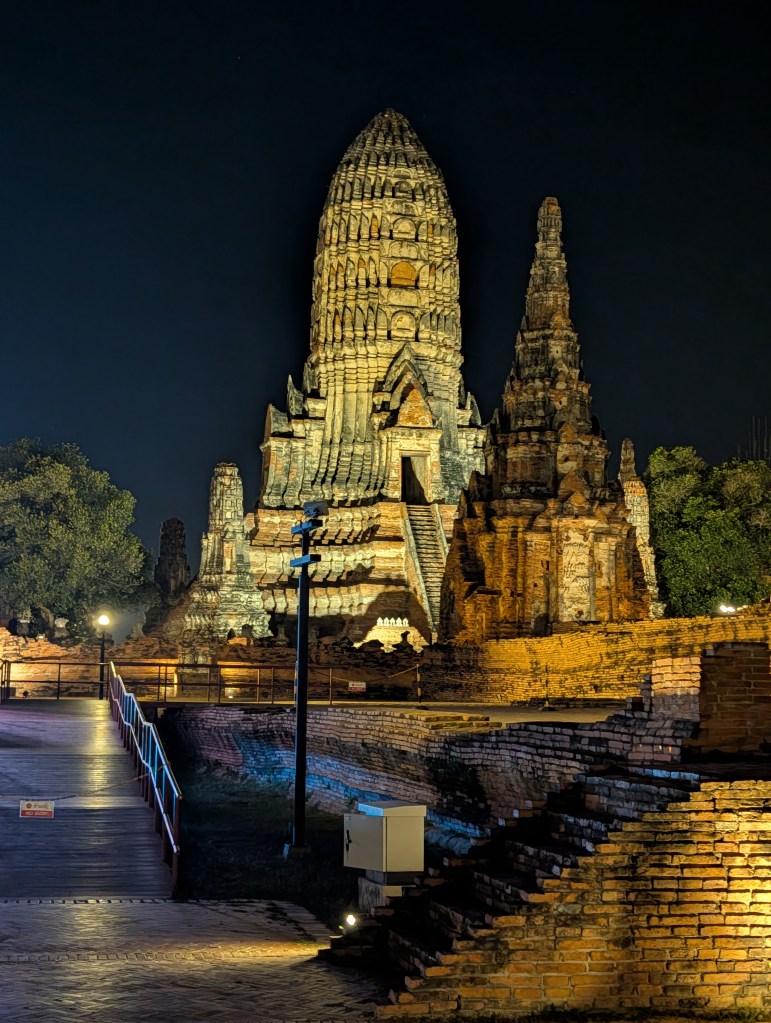
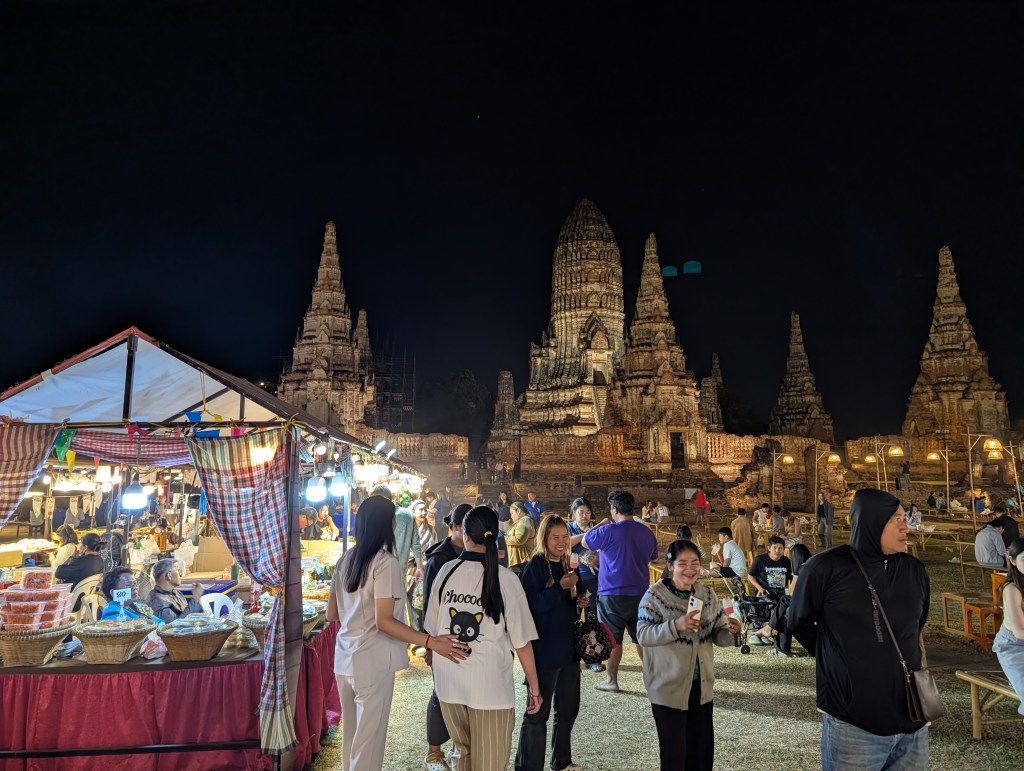
This evening we got to attend a festival on the temple grounds. There was a stage set up with Khon performances, and a large area occupied by food stalls. All while we were in Thailand I had been smelling delicious grilled meat from roadside stalls but since most of our meals were pre-arranged I could do little more than inhale and salivate. At the temple we took advantage of a number of barbecue stalls, so we got some chicken satay, and pork skewers, and I think we had some grilled shrimp as well. We spent a couple of hours there in all, then tukked back to our hotel and enjoyed a riverside cocktail before packing for travel the next day.
Overall I liked Ayutthaya a lot and found myself wishing we had more time there. I would have liked to spend a free day wandering around the archaeological park, the way we did at Angkor. We managed a little walking around town but not as much as I would have liked.
Next time: The Poconos of Thailand!
 The Cambias Digression
One response to “The Great Indochina Expedition, Episode 12: Palaces, Monks and a Festival”
[…] Next time: Temples! Palaces! Grilled meat! […]
LikeLike