
On January 5 our guide Sita really put us through our paces. We met her at 8:00 a.m. for a brisk walk to the Lumphini metro station, where we learned how to navigate Bangkok’s subway. It’s a pretty impressive system, especially considering it’s dug deep under a swampy river delta. I can only assume that somewhere are some really big pumps working constantly to keep it from turning into the world’s biggest underground swimming pool.
We rode to the “old city” section in order to visit the Wat Phra Chetuphon temple complex, home to the tombs of Kings Rama I through Rama IV. They were a pretty impressive bunch, who solidified the Chakri dynasty’s power over Siam and steered the country onto a path of modernization. The tasks they faced were kind of mutually exclusive: keep themselves and their family in power, expand and modernize the kingdom, and somehow also keep from being swallowed up by any of the great colonial powers. One can probably disagree about specific policies and actions while still acknowledging that they pulled off an almost impossible task.
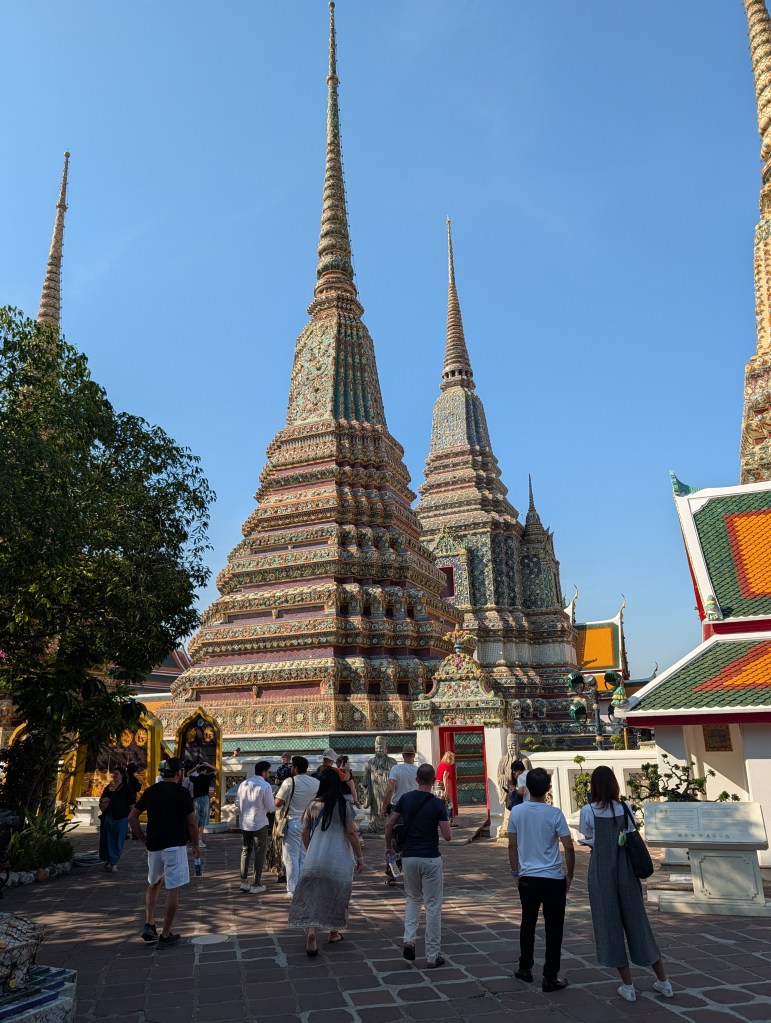
The reason we got to the temple so early was to sit in on the morning chants by monks in the main sanctuary. Again, we did our best to dress and behave respectfully. After that we wandered over to the Reclining Buddha temple to see the World’s Biggest Reclining Buddha statue, all 46 meters of it.
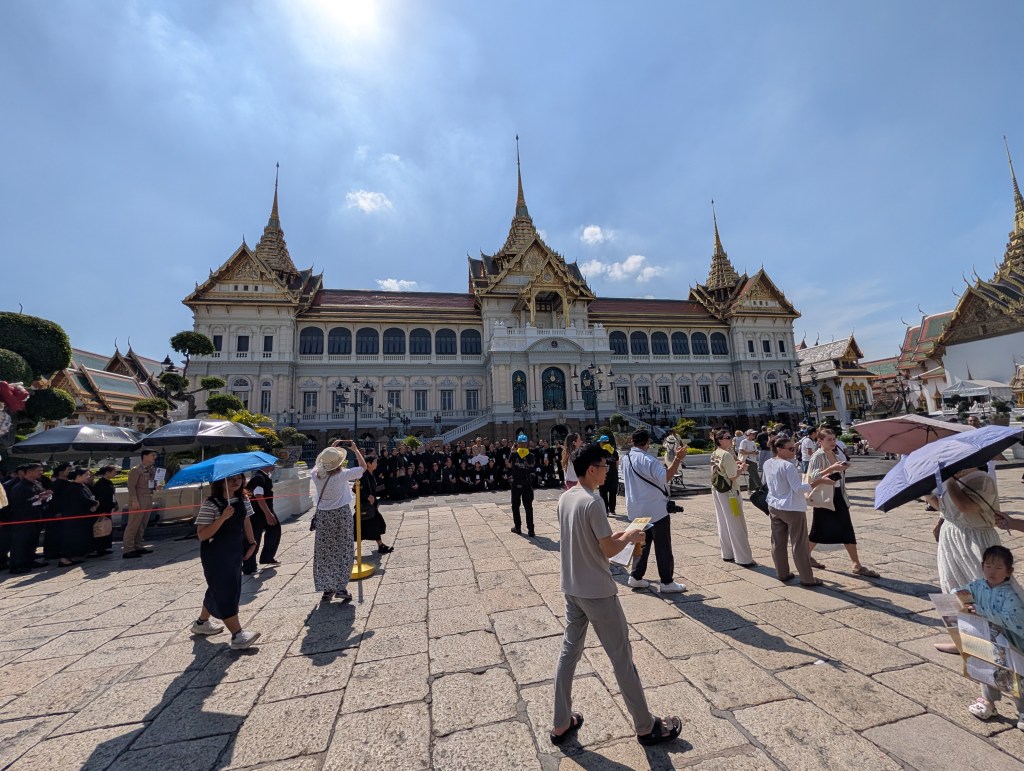
But that was just the first course. From the temple we walked next door to the Grand Palace, the official residence of the King of Thailand and the royal family. Apparently the King spends a lot of his time abroad — which could possibly be attributed to the large number of tourists visiting the palace. If I had ten thousand people a day walking through my back yard I’d want some place more private, too.
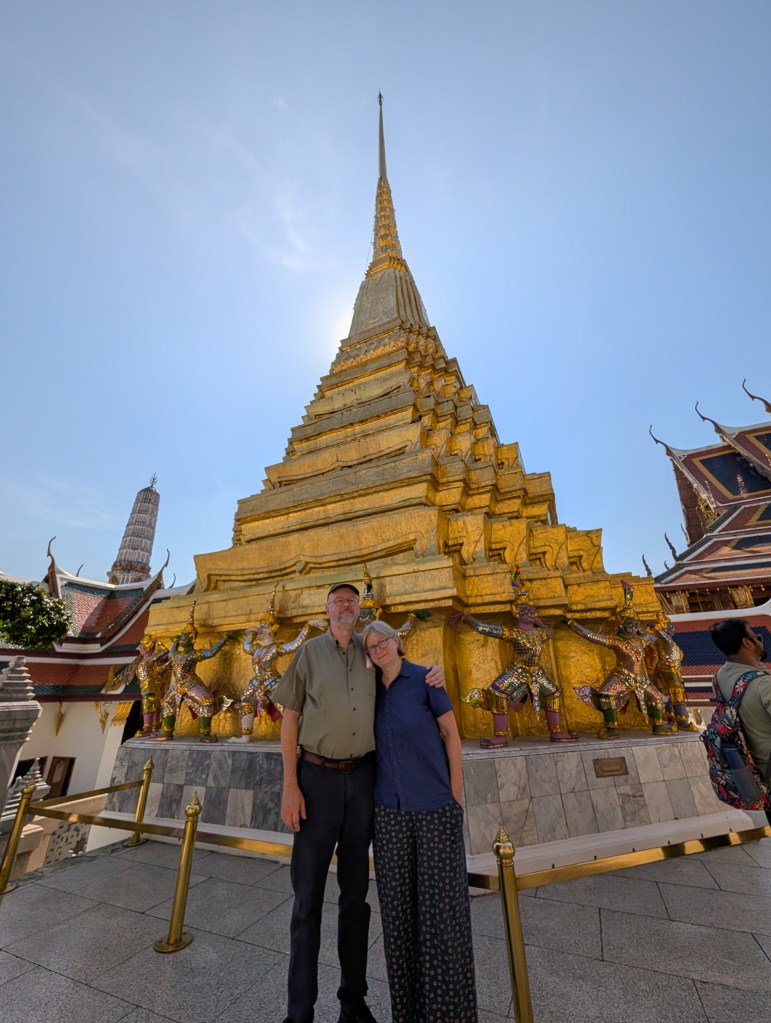
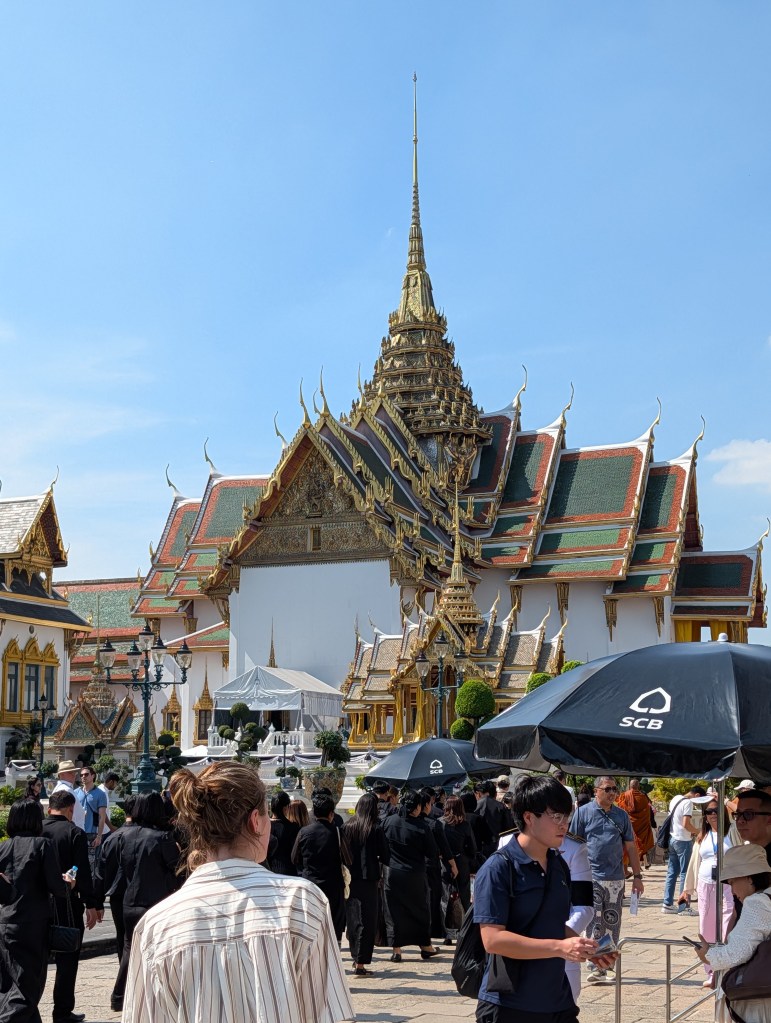
We had been warned in advance to wear somber colors to the palace, as the whole country was still in mourning for the late Queen Mother, who died back in October of 2025. Everywhere we went in Thailand we saw pictures of her draped in black and white bunting or flowers. No doubt there’s a certain amount of official encouragement going on, but the crowds of black-clad Thai visitors arriving by bus from the provinces to file through the palace seemed pretty sincere.
Henri Mouhot was invited to dine at the palace in 1858
“. . . I received an invitation from the King of Siam to be present at the great dinner which this monarch gives every year, on his birthday, to the European residents in Bangkok. I was presented by Monseigneur Pallegoix, and his Majesty’s reception was kind and courteous. His costume consisted of a pair of large trousers, a short brown jacket of some thin material, and slippers; on his head he wore a little copper helmet like those worn by the naval officers, and at his side a rich sabre. Most of the Europeans in Bangkok were present at the dinner, and enthusiastic toasts were drunk to the health of his Majesty, who, instead of being seated, stood or walked round the table, chewing betel and addressing some pleasant observation to each of his guests in turn. The repast was served in a vast hall, from whence we could see a platoon of the royal guard, with flags and drums, drawn up in the courtyard. When I went to take leave of the King, he graciously presented me with a little bag of green silk, containing some of the gold and silver coin of the country, — a courtesy which was most unexpected, and for which I expressed my gratitude.”
The King in question was Rama IV, whose tomb we saw next door at the temple. He’s probably better known as Mongkut, or “the Yul Brynner guy.” I can only admire the King’s wisdom. Instead of sitting through a boring dinner with a bunch of drunk foreigners, he kept moving, didn’t let himself get pinned down by some blowhard, and — if my own betel experience is any guide — stayed high as a kite all evening.
M. Mouhot was very impressed by King Mongkut, and not just because he got a big party favor.
“This King, whose official title is Somdel Phra, Paramanda, Maha-Mangkut—that is, His Majesty the King, encircled with the Great Crown—was born on the 18th October, 1804, and mounted the throne of Siam in the year 1851. The first part of his life was passed in complete retirement in a monastery, in this following the example of many of his predecessors: for all sects emanating from Buddhism think it necessary that the rulers of nations should prepare themselves for supreme power by a previous life of repose and sanctity.
“It was only after the accession of Somdel Phra that the mastery he had gained over the most difficult sciences became known. After having applied himself to the history and geography of his country, he turned to the study of astronomy, natural philosophy, politics, and philology. He was familiar not only with all the dialects of Siam and Indo-China, but also with ancient Sanscrit and English, in which latter language he had written several treatises. The English journals at Hong-Kong have been honoured by articles from his pen, and no one who reads them can be surprised that the august contributor should have been elected a member of the Asiatic Society in London, a body which reckons on its list so many savants of the first rank.
“His Majesty had also acquired a fair knowledge of Latin from the French missionaries, especially from Archbishop Pallegoix, who has been his friend for thirty years. He studied astronomy almost without a master, and had gained such proficiency in that science as to be able to calculate an eclipse and determine the latitude and longitude of a place. He introduced a printing-press into his dominions, in which both Siamese and Roman characters are used. His language testifies to his education and intelligence, though it more resembles the phraseology of books than that of ordinary conversation.”
The King’s interest in astronomy ultimately led to his death. In 1868 he noted that the path of totality of a solar eclipse would pass across Thailand near the town of Wakor, on the Malay peninsula, so he organized a Royal expedition to view it. The King — and the eclipse — arrived at Wakor on schedule in August, but unfortunately in the relatively wild rural district His Majesty got a mosquito bite and subsequently died of malaria just before his 64th birthday. At least he did get to see the eclipse, which is always worth doing. (As a side note, we used a lot of insect repellent during this trip, especially since hotel operators in Indochina appear to believe window screens are for sissies.)
Within the walls of the Grand Palace (which look as though they were built to be real fortifications, just in case somebody decided a different dynasty should have a turn) we saw some of the wonders of Bangkok.
There’s the Temple of the Emerald Buddha. It’s carved from a single chunk of jasper, and gets dressed in different outfits over the course of the year. Its exact provenance is unclear, but the Emerald Buddha bounced around Indochina for several centuries as one kingdom captured from another, but in 1779 the Siamese army took it from Laos, and in 1785 it was installed in the newly-built temple on the palace grounds, where it has remained ever since.
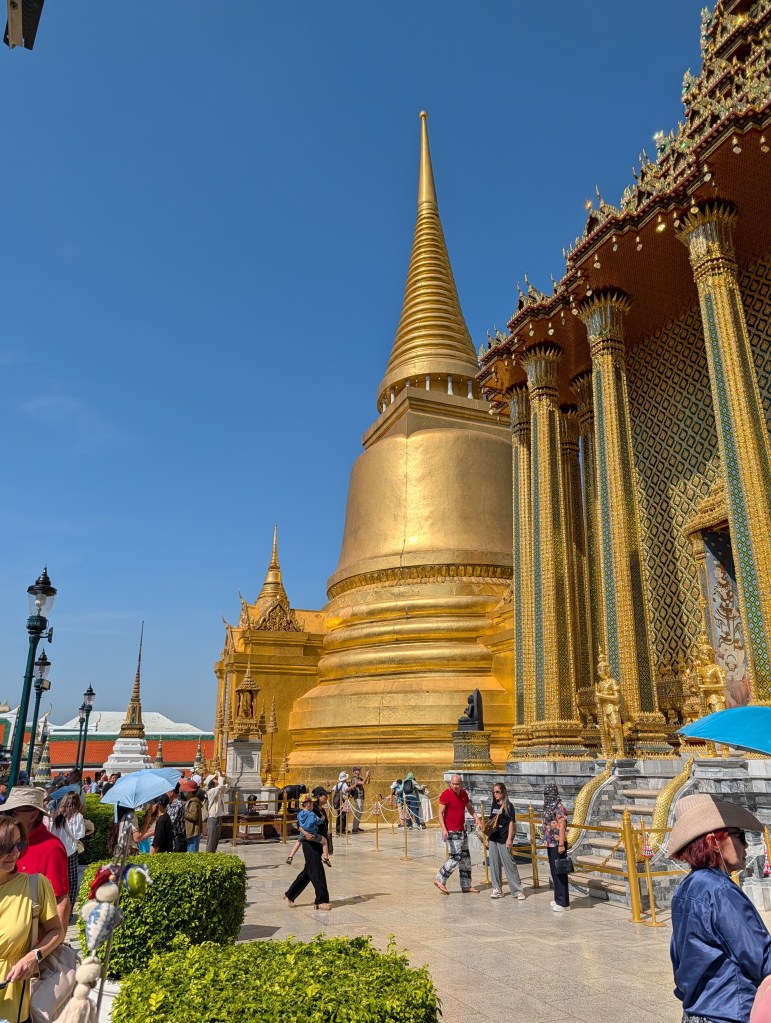
There’s a stupa built to house some of the ashes of the Buddha himself, generously donated by the Government of India.
There’s the modern royal palace itself, a curious — but not unattractive — fusion of Thai and Western styles. It’s got a multi-spired pagoda roof and Corinthian columns.
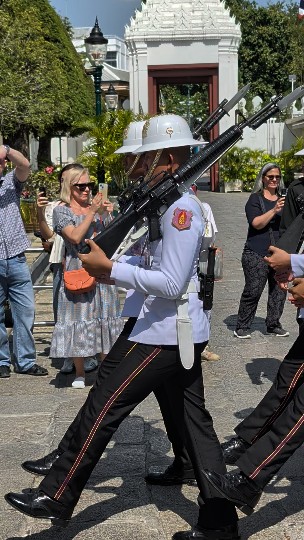
While we were there we got to watch the noontime changing of the guard, every bit as precisely-choreographed as at Buckingham Palace or Arlington Cemetery.
After that we boarded a water bus on the river and motored back downriver again while having a snack of some really excellent fresh pineapple. The Chao Phraya is still a “working” river, with barge traffic going up and down. I didn’t see any ocean-going ships — it was the dry season so water levels in the river may have been an issue.
We disembarked and rode the “Sky Train” (which any Chicagoan would call the El) over to the Jim Thompson house, where our guide bid us goodbye for the afternoon. Who was Jim Thompson and why did we go to his house? James Harrison Wilson Thompson was a veteran of the O.S.S. in World War II, who was sent to Thailand just before Japan surrendered, and decided to settle there. He did a lot to popularize Thai silk fabrics in America and Britain (his silks were used for costumes in the Broadway production of The King and I), turning the Thai silk industry from a local handicraft to a substantial industry.
His house is modeled on traditional Thai architecture — not unlike Cambodian houses, with the living spaces located on stilts over an open ground floor. Thompson furnished his house with art and antiquities from Thailand and elsewhere in Asia. And then in 1967 he paid a visit to Malaysia and . . . vanished.
Dr. Kelly, the big spoilsport, noted that he was 61 years old at the time and was already taking medication for heart problems, so the most plausible explanation is that he had a heart attack (or just fainted) while walking alone in the Malaysian wilderness, died from falling or natural causes, and then animals and the jungle did the rest.
But in 1967 there was a lot of dangerous stuff going on in southeast Asia. An ex-spy with contacts high in both the U.S. and Thai government might attract some unfriendly attention from Communist agents, or someone else with a score to settle. Or maybe the Tcho-Tchos got him.
Having already bought some silks in Siem Reap, we got through the gift shop at the Thompson house without buying anything, and then navigated back to the U Sathorn by Sky Train and foot, all by ourselves.
That evening we dined at a French restaurant called Cagette near our hotel. It was quite good — and since two of the other tables were occupied by people speaking French, I guess they shared my opinion. As I already mentioned, Bangkok’s a cosmopolitan place. Not only is there good Thai food, there’s apparently good French food as well.
Then back to the absurd bed, very tired.
Next time: Boats!
 The Cambias Digression
One response to “The Great Indochina Expedition, Episode 9: Around Bangkok Four Ways”
[…] Next time: The Kings and I […]
LikeLike