
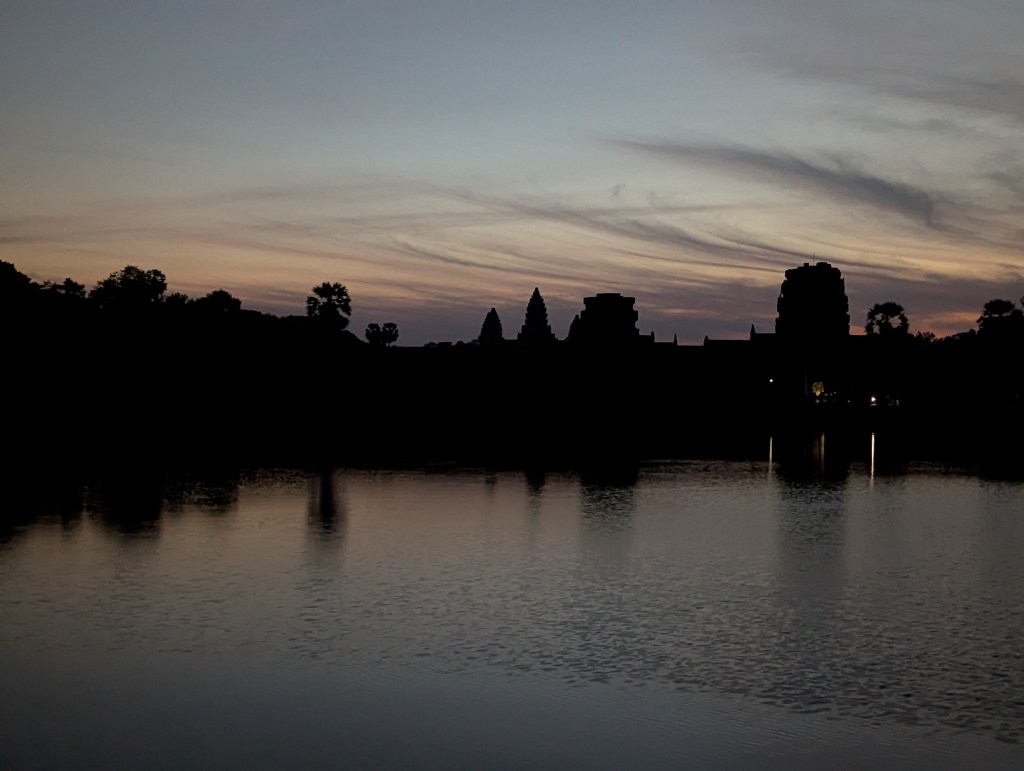
After such a busy day on January 1, you might expect us to sleep late the next morning. That was not to be. We arose on the 2nd at 4:30 a.m. and took a chilly tuk-tuk ride through the darkness to the western bank of the moat around the Angkor Wat temple complex, in order to watch the Sun rise over the temple. Nor were we alone — there must have been a couple of hundred people lined up at the water’s edge, cameras and phones at the ready.
The dawn was indeed pretty, and the towers of the temple did look impressive silhouetted against the brightening eastern sky. Once the Sun finally cleared the horizon we crossed the bridge and had a look at Angkor Wat.
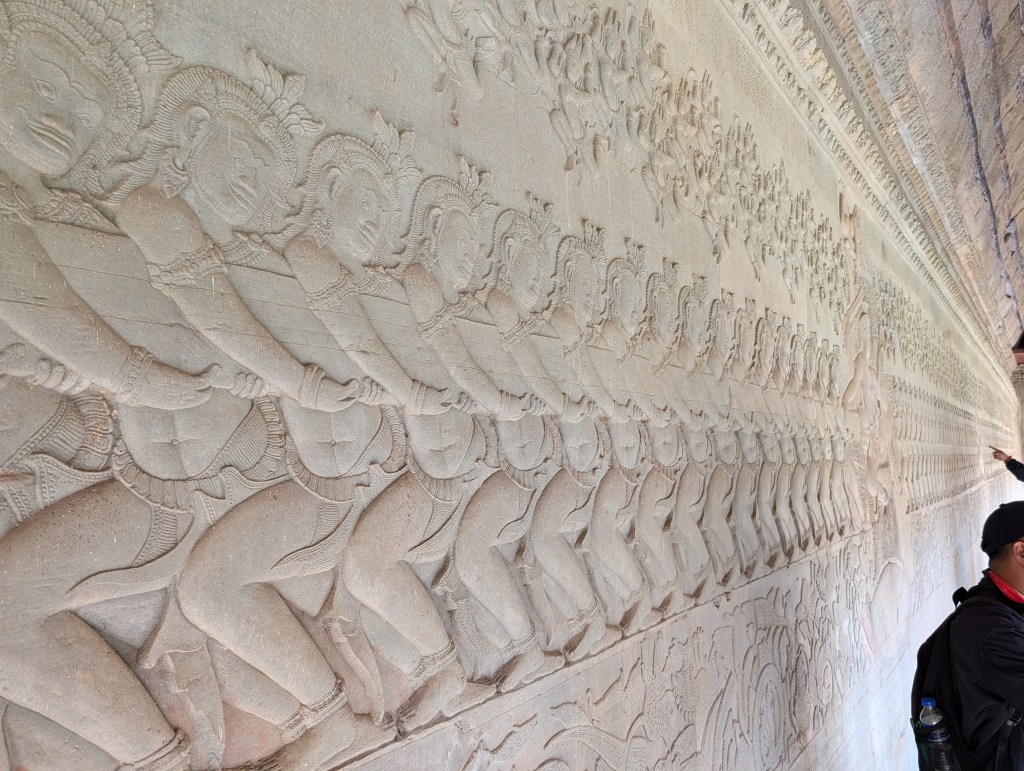
Like Wat Bayon in Angkor Thom just to the north, Angkor Wat is an active Buddhist temple, so modest attire is required. Mr. Saom gave us a tour of the place. It was built originally as a Hindu temple, then was used jointly by Hindus and Buddhists, and nowadays I think it’s exclusively Buddhist. The sculptures inside are a mix of both traditions. There’s an enormous relief showing the “churning of the sea of milk” from Hindu creation myth, and of course a lot of Buddha figures.
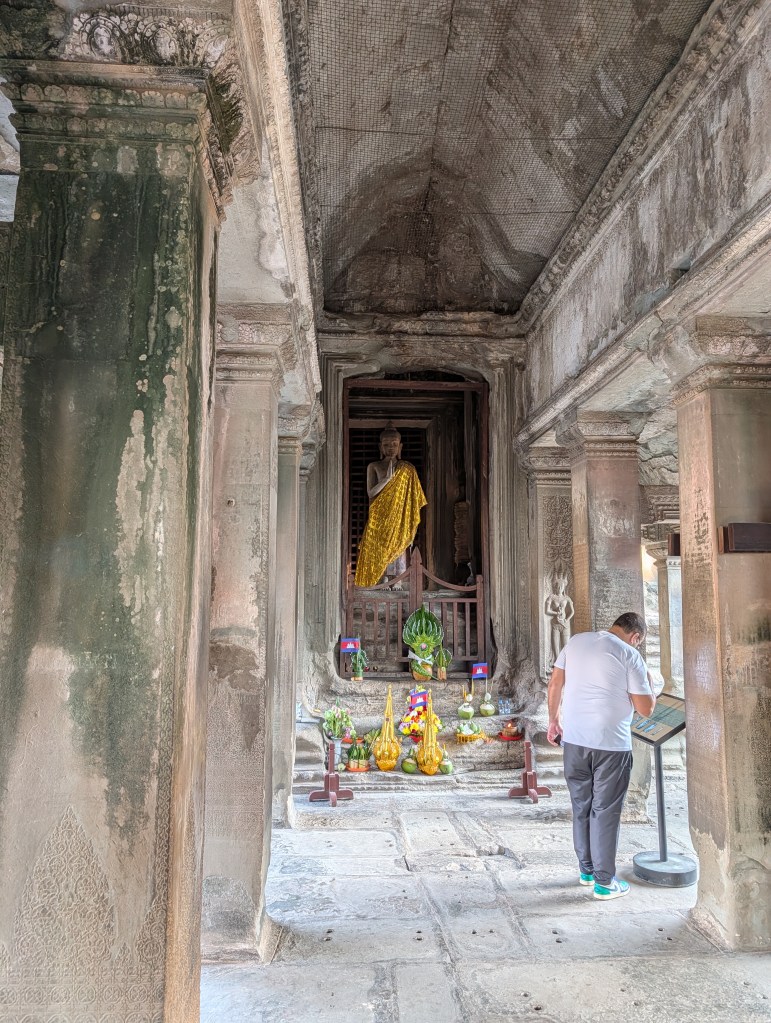
The place was absolutely packed, even just after dawn. According to our guide Senghong, Angkor Wat gets about 2 million visitors a year and I can believe it. We prowled around the temple, climbed up the steep stairs to the upper level, and then made the even more perilous climb back down again.
Zhou Daguan never bothered to mention Angkor Wat, but Henri Mouhot devoted a whole chapter of his account to the site. Most of it consists of measurements. (“Commencing from the building which forms the principal entrance, is a second causeway, 9 metres wide by 342 metres in length; it is raised 1 metre from the level of the ground.” On and on and on. You could practically build a replica of the complex from his data.)
Amid the technical specs M. Mouhot occasionally permits himself some description. Here’s his account of the battle between the army of Hanuman and the forces of the demon king Ravana, from the Ramayana:
“The bas-reliefs represent the combat of the king of the apes with the king of the angels: in the centre is the king of the angels, drawn by two griffins; he has seven heads and twenty arms, with a sabre in each hand. Some of the chiefs are seated in cars drawn by fabulous animals, while others are mounted on elephants. The soldiers are armed with bows, javelins, or sabres, but the apes have generally no weapons except their formidable claws: a few of them have clubs, sabres, or branches of trees.”
The whole place came as a revelation to M. Mouhot, and apparently none of his local informants could provide much background about it.
“All the mouldings, sculptures, and bas-reliefs appear to have been executed after the erection of the building. The stones are everywhere fitted together in so perfect a manner that you can scarcely see where are the joinings; there is neither sign of mortar nor mark of the chisel, the surface being as polished as marble. Was this incomparable edifice the work of a single genius, who conceived the idea, and watched over the execution of it? One is tempted to think so; for no part of it is deficient, faulty, or inconsistent. To what epoch does it owe its origin? As before remarked, neither tradition nor written inscriptions furnish any certain information upon this point; or rather, I should say, these latter are as a sealed book for want of an interpreter; and they may, perchance, throw light on the subject when some European savant shall succeed in deciphering them.”
We eventually returned to the hotel for breakfast and a nap. This marked the official end of our tour, except for a final dinner. Dr. Kelly and I did walk about Siem Reap a little more.
The last dinner was at a high-end restaurant in Siem Reap whose name escapes me. Supposedly it’s run by a chef who formerly worked in the Royal household. It was . . . okay. The menu was all things we’d already tried elsewhere, all made very well but not exciting.
The tour was over and most of our companions headed off to the airport on January 3 to fly home. We stayed an extra day and I’m very glad we did. We had a sturdy breakfast and then used one of the same tuk-tuks which had carried our tour group (piloted by a Mr. Pum) for a return trip to Angkor Thom in order to see some of what we had missed.
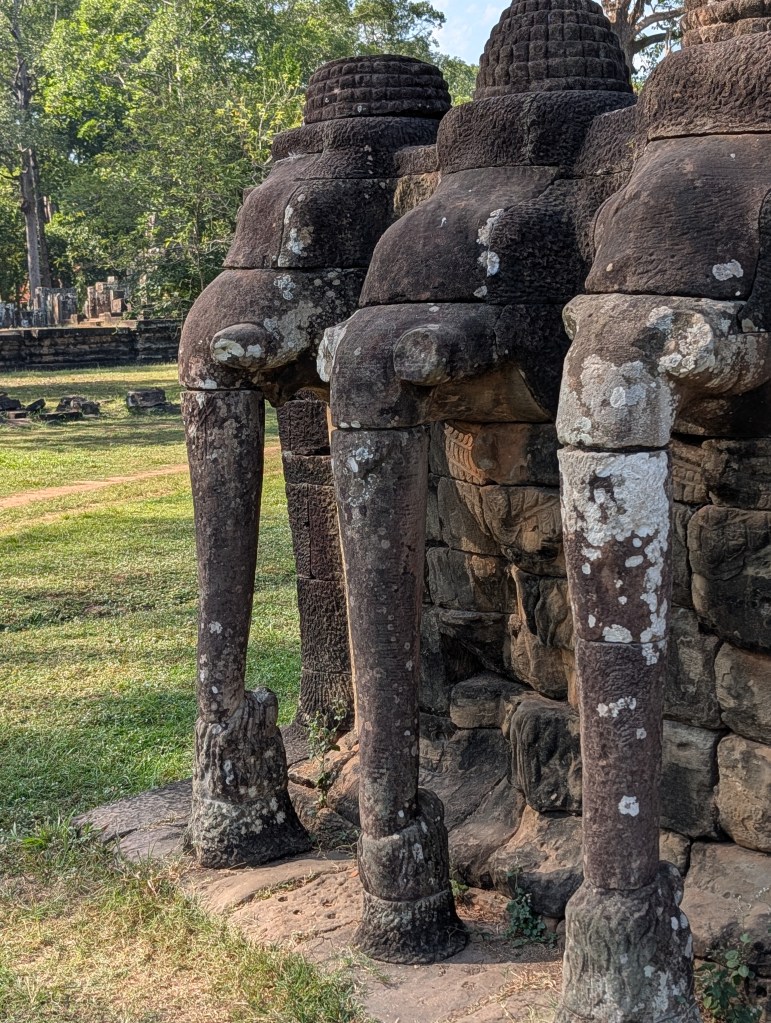
Mr. Pum dropped us at the Terrace of the Elephants, which was once part of the palace complex of the Khmer rulers. We spent a couple of hours wandering around the ruins of the palace and looking at a series of small towers across the road whose purpose was obscure.
Zhou Daguan described the palace in detail:
“The royal palace, officials’ residences, and great houses all face east. The palace lies to the north of the gold tower with the gold bridge [Bayon], near the northern gateway. It is about five or six li in circumference. The tiles of the main building are made of lead; all the other tiles are made of yellow clay. The beams and pillars are huge, and are all carved and painted with images of the Buddha. The rooms are really quite grand-looking, and the long corridors and complicated walkways, the soaring structures that rise and fall, all give a considerable sense of size. In the place for doing official business there is a gold window, with rectangular pillars to the left and right of the crosspieces. About forty or fifty mirrors are arrayed on either side of the upper part of the window; the lower part is made of images of elephants. I have heard that there are many wonderful places in the inner palace, but it is very strictly out of bounds and I could not get to see them. Inside the palace there is a gold tower, at the summit of which the king sleeps at night. The local people all say that in the tower lives a nine-headed snake spirit which is lord of the earth for the entire country. Every night it appears in the form of a woman, and the king first shares his bed with her and has sex with her. Even his wives do not dare go in. At the end of the second watch he comes out, and only then can he sleep with his wives and concubines. If for a single night this spirit does not appear, the time has come for this foreign king to die. If for a single night he stays away, he is bound to suffer a disaster.”
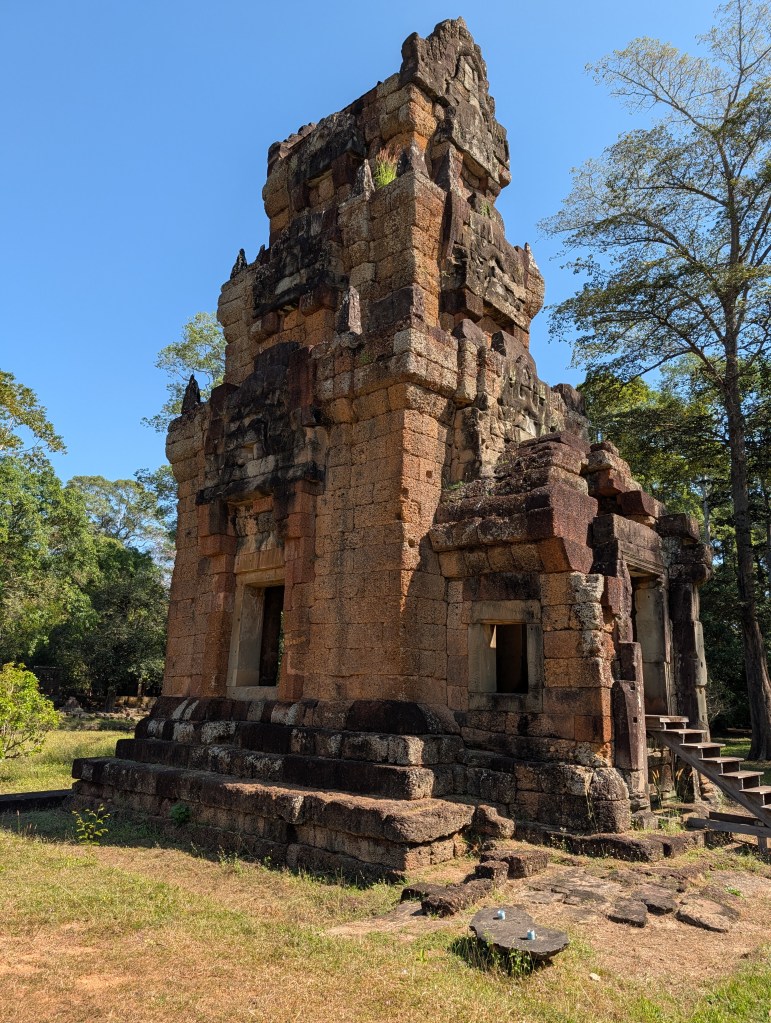
The towers across the road, known as the Prasat Suor Prat towers, may have been part of the justice system. According to Master Zhou:
“Then again, if two families have a dispute to resolve and cannot agree on right and wrong, there are twelve small stone towers [Prasat Suor Prat] on a bank opposite the palace, and the two people concerned are sent to sit in two of them. Outside, members of each family keep guard against the other. They may sit in the towers for a day or two, or for three or four days. Then for sure the one who is in the wrong becomes visibly ill, and leaves. He may have sores, or a cough or fever or something of the kind. The one who is in the right is absolutely fine. Thus right and wrong are assessed and decided on, in what is known as the judgment of heaven. Such is the spiritual power of the local gods.”
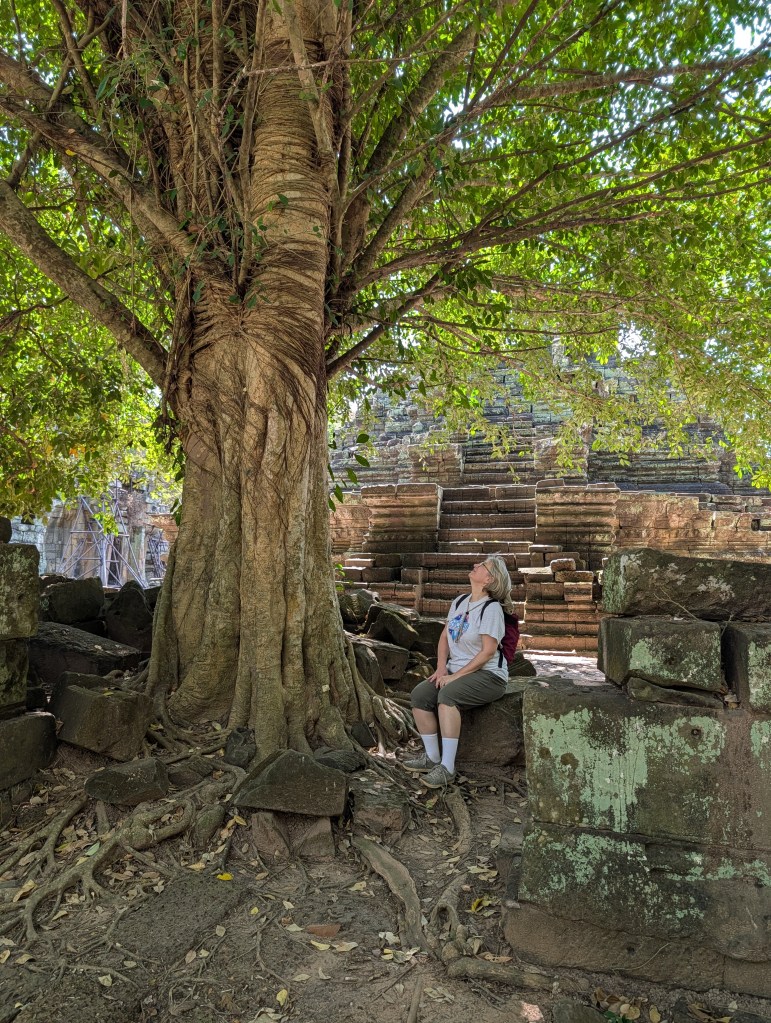
On our way out of Angkor Thom I noticed another huge temple complex off to the north, so we made a brief stop at the Preah Khan temple, long enough for me to walk in and out again. It was rather crowded and the interior chambers were tiny, making it hard to move around. A group of — officials? business people? People’s Party members? retired gym teachers? — wearing matching Cambodian flag polo shirts were touring the place and formed a moving roadblock impossible to get past.
That night we had a simple dinner near the hotel and went to bed early, as we had an early flight out in the morning.
Next time: cue Murray Head!
 The Cambias Digression
One response to “The Great Indochina Expedition, Episode 7: Angkor Again and Again!”
[…] Next Time: Angkor Angkor Angkor! […]
LikeLike