
December 30 was our first full day in Siem Reap. We kicked off the day with a visit to the Wat Bo temple (I’m being redundant here: “Wat” means “Temple,” but it does make the whole thing more clear), not far from the Rambutan hotel. Wat Bo is an active Buddhist monastery, and indeed we saw some of the monks in their robes during our visit. The main sanctuary is going on three centuries old, and has some intriguing wall paintings from the 19th century. Some are scenes from the life of the Buddha, others just look like stuff going on in 19th-century Cambodia.
This sanctuary — like all the other Theravada Buddhist temples we visited on this trip — reminded me strongly of old churches in Italy and France. There’s the mix of old and new, for in addition to the 200-year-old wall paintings the sanctuary also featured a spiffy LED halo behind the head of the main Buddha figure in the center.
The Buddhist temples just feel “churchy” — and I can imagine that affected European attitudes when they first encountered these societies. If you’re a French explorer and you look into a Wat in Cambodia, your first thought will be, “This is a church. Those are monks. I get this.”
From Wat Bo we tuktukked a quarter-mile north to see some public art on display in the plaza between the Summer Palace of the King of Cambodia and the fancy old Raffles hotel. (The King wasn’t around. According to our guide he spends most of his time in China.) There were statues of heroes of the Khmer Empire, a stylized modernist fruit sculpture, and a mural depicting Thai aggression with the King and Prime Minister Hun Sen looking concerned. We also got some fried bananas there, which were delicious.
Then up to Theam’s Gallery, a fascinating place about a mile away on the northwest side of Siem Reap. Mr. Theam is an artist in several media, and like many modern Cambodian artists, his works try to make sense of his country’s awful history. But the gallery is more than just a shop: it’s a sprawling complex showcasing not only the works of Theam and other artists, but examples of Cambodian architecture and interiors, which apparently he collected and moved to the site. It’s like visiting a wizard’s house, full of unexpected rooms and little gardens, and just when you think you’ve navigated through the whole place you realize there’s an entire upper floor you haven’t visited. We spent at least an hour at Theam’s and probably could have spent a day.
We got lunch at a very hip establishment called Brother Bong’s, back in the heart of Siem Reap (Tom Yum soup and Beef Loklak plus some more amazing coffee), then spent the afternoon napping and having a swim back at the hotel.
At four that evening we traveled by tuk-tuk to a place on the southwest — I think? — side of town for our Cambodian cooking lesson. Under the guidance of a professional chef, we eight tourists prepared our own dinner, starting with dessert and working backward. The dessert course was mango sticky rice, so we heated palm sugar until it was liquid and then combined it with cooked rice and coconut milk, cooked until the coconut reduced, and then put aside to cool and set.
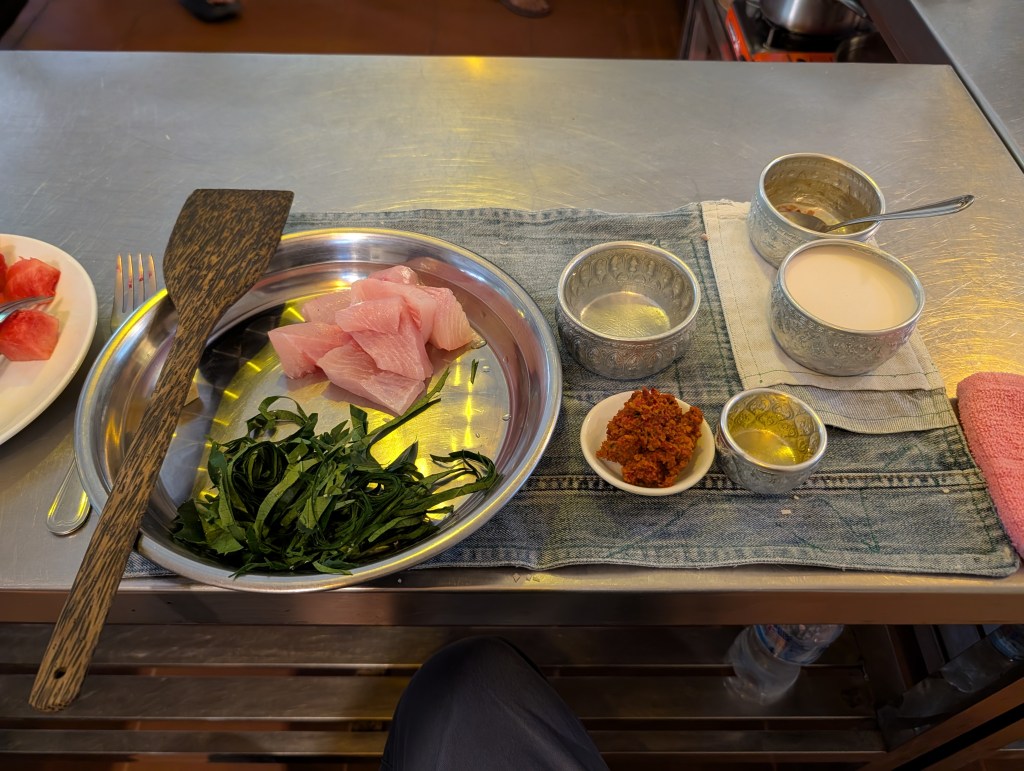
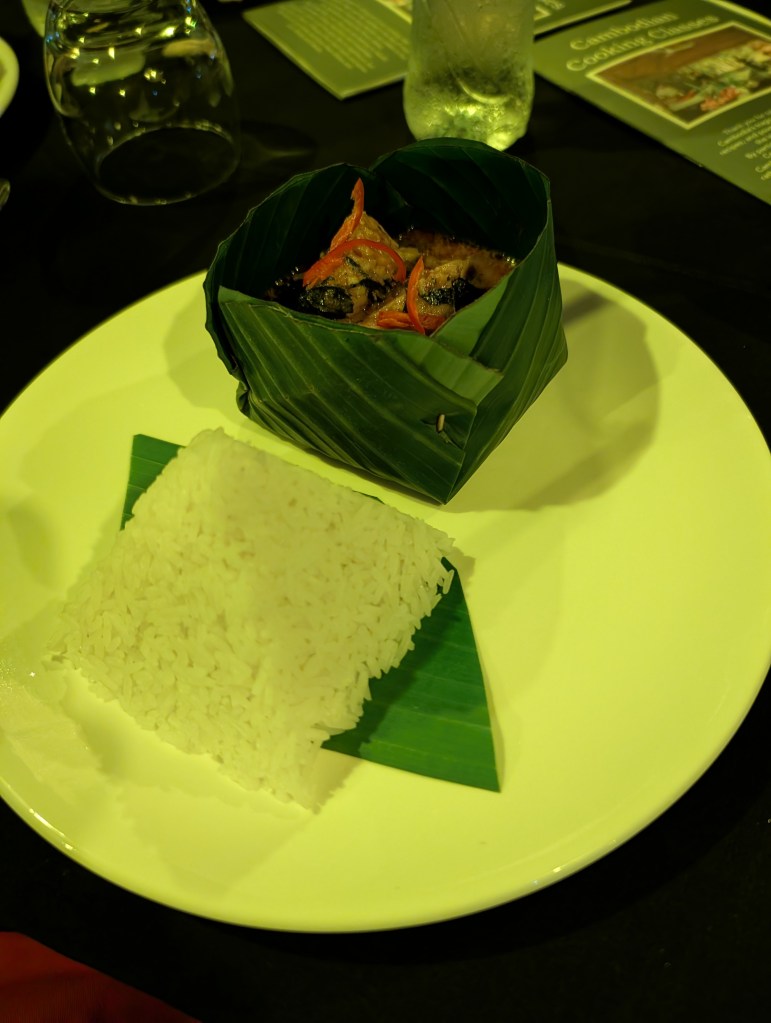
The main course was amok fish. That doesn’t mean a fish gripped by murderous rage, it means fish flavored with the spice paste called amok, made by mashing up lemongrass, galangal, turmeric root, lime, and black pepper in a mortar until it forms a smooth orange paste. To cook the fish you combine that with coconut milk and braise the fish with some vegetables and aromatics. I don’t think I was told what sort of fish we were using, and I don’t think it matters — the spice overpowers the fish itself, so you might as well just use whatever’s on sale.
We took a break from cookery to make some cocktails, starting with a concoction of coconut rum, vodka, lemongrass syrup and lime juice, which was dangerously refreshing. Dr. Kelly, who is usually a lightweight where alcohol is concerned, downed her glass as if it was Sprite. I kept an eye on her to see if she would throw up or pass out, but it apparently had no effect.
The final dish we prepared was our appetizer, a salad of green mango with cooked chicken — the only dish of the evening which did not involve coconut. With that done we adjourned to a lovely little pavilion beside a pond where turtles watched us hoping for scraps. Another round of cocktails and the meal began.
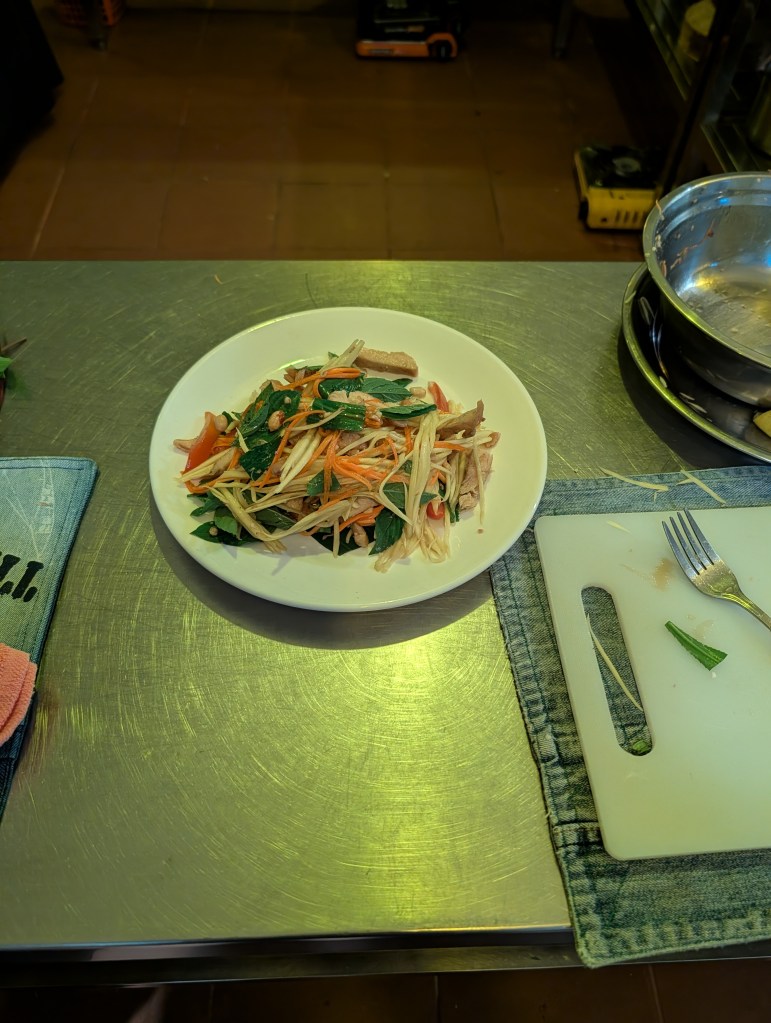
It quickly became apparent that our professional instructor was “helping” our cooking out a little. When the amok fish came out it was accompanied by elegant little pyramids of rice, and the sticky rice dessert had been shaped neatly into rectangles and topped with neatly-sliced mango. All delicious, though I confess my appetite for sweetened sticky rice is limited. We got a little cookbook brochure with recipes, and when warm weather comes I do mean to try some of them again.
The evening wrapped up at a karaoke parlor in downtown Siem Reap (as I said, it’s a tourist center). We discovered that the two guides both sing very well, and the rest of the group got to learn something I’ve known for a while: Dr. Kelly has a good voice but gets stage fright, while I don’t sound as good but am utterly fearless in front of an audience.
The following day — New Year’s Eve of 2025 — we did more Food Tour stuff in and around Siem Reap. Our first stop (as always, via tuk-tuk) was at a market, fairly similar to the one we visited in Phnom Penh. As before, it was crowded, not too clean, and fascinating. We sampled some green lotus fruit and fermented daikon radish.
Zhou Daguan saw markets here, as well: “The local people who know how to trade are all women. So when a Chinese goes to this country, the first thing he must do is take in a woman, partly with a view to profiting from her trading abilities . . . There is a market every day from around six in the morning until midday. There are no stalls, only a kind of tumbleweed mat laid out on the ground, each mat in its usual place.” Seven hundred years later some (but not all) of the market stalls have tables. The ones who still put out a mat use bamboo, usually with a tarp underneath.
Then out into the country (and I frankly have no idea where) for a visit to a traditional Cambodian farm. The family grow coconuts, bananas, lotus, betel, and I think have a rice field as well. They also raise fighting cocks, whose house even got its own little Buddhist shrine for protection. The fresh-picked coconut was very refreshing. The betel (as in “betel nuts”) is very bitter — and about ten minutes after chewing a piece about the size of a penny I felt as if I had just downed a small glass of vodka in one gulp. When you see references to people “chewing betel” in old novels or travelogues, that means those people are mildly stoned.
It’s supposed to be good for the teeth, though continued use discolors them.
This points up something important about Cambodia — the incredible fertility of the land. A farm of just a couple of acres supports a family with enough left over to take to the market for cash. Frost just never happens. Farms can get two or more crops per year. I’m not the first to notice this, of course. Zhou Daguan reported, “In general crops can be harvested three or four times a year,” though I think he may have been a bit over-optimistic there.
Why is this important? Because Cambodian agriculture still has immense un-tapped potential. The farmers are still mostly growing for their own use and the market in town. Cambodia’s agricultural exports amount to about two and a half billion dollars, a tenth of their total exports. But with their splendid climate and abundant water supply, they could surpass California, which has an agriculture sector producing nearly three times as much in value. Forget rice! Cambodia could supply fruits and vegetables for all of eastern Asia, especially the bigger, richer, colder countries.
From the farm we tuktukked to a pottery studio, where we all got to play with chunks of yellow river-bottom clay making dishes and pots. It was entertaining, but of course we didn’t have time to fire our pots, glaze them, fire them again, and all the other aspects of making ceramics. So we molded our clay, admired the results, and then left.
We lunched back in Siem Reap at a legendary noodle shop, the name of which I neglected to write down. The place was close enough to our hotel that Dr. Kelly and I decided to walk back rather than ride the tuk-tuk. We stopped at an ice cream parlor called the “Gelato Lab” in central Siem Reap, and did some shopping at a place called Artisans Angkor, which specializes in traditional silk textiles.
The rest of that afternoon was devoted to naps, and then we rejoined the rest of our tour for a visit to the Hero Rats of APOPO. What, you may ask, are the Hero Rats of APOPO? APOPO is an organization devoted to clearing out land mines and other unexploded ordnance — and there’s a lot of that stuff littering the landscape all over the world. (The name is an acronym but I’m damned if I can find what the letters stand for.) Anyplace there’s a civil war, or an uncivil one, it’s almost certain that one side or other is going to start scattering land mines around like Carnival throws. Cambodia got a bunch of bombs dropped on it during U.S. efforts to choke off the Ho Chi Minh Trail in the 1960s, then had a couple of civil wars when everybody planted lots of mines — and the Khmer Rouge seem to have been even more enthusiastic about land mines than most regimes, with basically no record-keeping at all.
So you have to find them and deactivate them, otherwise farmers plowing fields, or gathering firewood in the forest, or (even worse) children curious about the funny metal thing they found, get killed or severely injured. But doing this the way armies do it, with guys carrying metal detectors, is slow and tedious. Metal detectors can’t distinguish between a live mine or bomb, a random chunk of metal, or a discarded can of beanie-weenies. All false positives have to be treated as a possible explosive, which means the whole process takes forever.
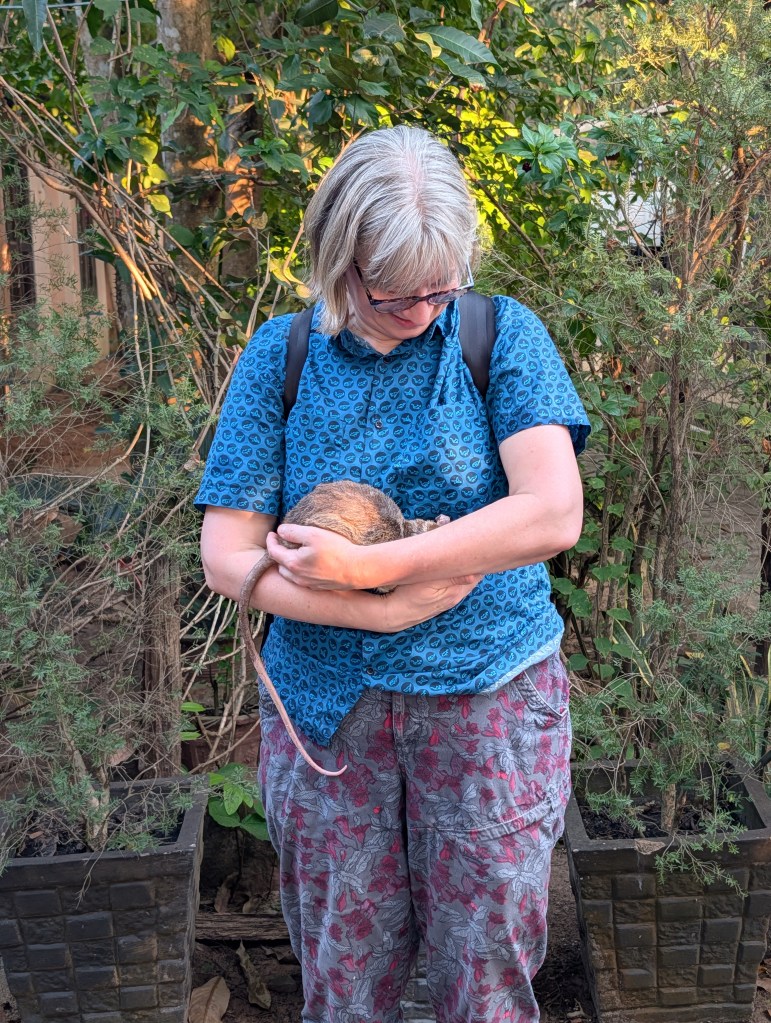
But animals — dogs, rats, various others — can be trained to recognize the smell of the most common types of explosives. Dogs, unfortunately, are often heavy enough to activate mines by stepping on them. But rats are light. They don’t trigger the mines. Enter the Hero Rats. APOPO’s rats aren’t your everyday Norway rats, but rather African Giant Rats. They use the African rats because they live a lot longer than smaller rats, which means the organization doesn’t have to spend as much time training new bomb-sniffers.
We saw an impressive display of mines recovered from around Cambodia. They’ve basically got a complete collection of mines from every major arms producing country: British mines, Japanese mines, Russian mines, American mines, French mines, and Chinese mines. We got to meet a Hero Rat. Dr. Kelly got to hold it. Needless to say, we donated some cash to help support APOPO’s efforts.
And then, off to the circus! The PHARE Circus (not an acronym) is located on the west side of Siem Reap. It has no animals, and instead of separate acts each performance tells a single story through dance and acrobatics. One could almost call it an extremely athletic ballet. Inevitably, the story encapsulates the wrenching recent history of Cambodia.
I don’t know if the rest of the tour group went down to Pub Street to ring in the New Year, but I went to bed and slept like a rock.
Next time: Angkor!


One response to “The Great Indochina Expedition, Episode 5: In and Around Siem Reap”
[…] Next time: Stuff in Siem Reap! […]
LikeLike