
The original Lost Plate tour schedule included a day in Battambang, a city southwest of Tonle Sap lake. But because of the Recent Unpleasantness with Thailand, they dropped that from the schedule and routed us around the northeast shore of the lake instead. For the first time we did not travel by tuk-tuk: we had a bog-standard van which felt like we were riding in a Trailways bus on the Cambodian roads.
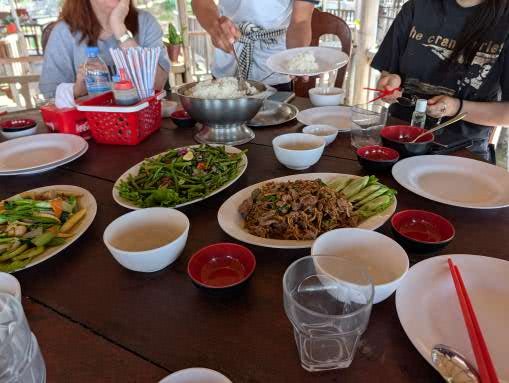
Our new route took us north and then northwest from Phnom Penh, following National Highway 6 all the way to Siem Reap at the other end of the big lake. They scheduled the drive for four hours but it took more like six. This was partly due to a long lunch break at Somros Prey Pros Restaurant at the halfway point on Prey Pras lake. Lovely place, with tables on platforms out over the little lake (just a tributary of the Tonle Sap, not the main body of water). We had chicken broth, ginger pork, and stir-fried morning glory vines.
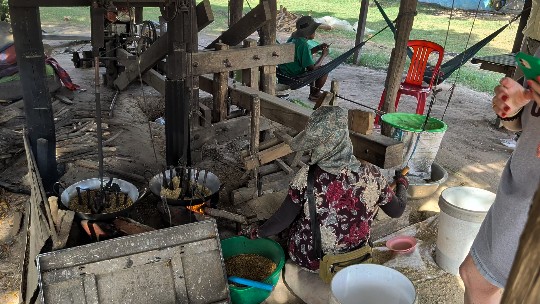
We also made a brief stop to look at some farmers by the side of the road doing rice-threshing using a traditional wooden log and big wood bowl — though instead of muscle power they had a tractor motor running the whole system.
The other reason the drive took so long is that National Highway 6 is your basic two-lane blacktop state highway lined with farmhouses and businesses, with plenty of local traffic. I don’t think we cracked 45 miles per hour the entire way.
Not that I minded. I can watch Cambodian traffic all day. Out in the country it was like Phnom Penh, but with a wider variety of weird and wonderful vehicles. The Honda 50 still rules the road, but in the country it’s got a rival: the all-purpose mini-tractor (same one used for rice threshing) converted into a propulsion unit for a big wagon made of boards, steered by two long handles. You also see flatbed trucks serving as impromptu buses with a dozen or more people riding in back. Here and there big Hyundai semis move ponderously along, staying just slower than the stream of lighter vehicles breaking around them. I think I saw more big trucks than family cars.
And yet more scooters! The demographics seem to be as follows: when you’re little, you ride around on the family Honda with the rest of the family. When you get to be around 12, you can sometimes borrow the scooter and go for a ride with your pals without adult supervision. In your teens you ride around with the same pals, two or three on the same bike (all boys or all girls, no mixed parties). Then when you do get a girlfriend or boyfriend, your pals have to find their own rides so the two of you can ride around on your bike together. Interestingly, the Cambodians are apparently not big on public displays of affection — but when a young couple are out riding around, it’s acceptable for the girl to cling tightly to the boy, even though when she’s riding with her Mom or Grandma she’s perfectly happy to perch sidesaddle looking at her phone. And then in the fullness of time, you get some kids and slide right into the family scooter ride already described.
We finally cruised into Siem Reap in the late afternoon and checked into the Rambutan Resort there. This is the bigger, fancier parent hotel of the branch we stayed at in Phnom Penh. Rooms are all arranged around a courtyard with a pool, built to evoke traditional Cambodian architecture. The bar makes a lovely mojito.
This is perhaps a good place to talk about Cambodian architecture. I mentioned that Phnom Penh is not a beautiful city. Nor, I regret to say, is Siem Reap. Nor were any of the towns in between. One glimpses the occasional handsome Buddhist temple, but that’s all. The rest of the buildings are mostly brutally functional. Here and there one sees what used to be a nice old farmhouse on stilts, but now the whole thing is hidden from view by giant sheet metal roofs overhanging the whole yard, and swathed in chain-link fencing covering everything else.
I was repeatedly assured that Cambodia is a safe country. Certainly I never felt unsafe, and I more or less stopped worrying about pickpockets after my second day. But . . . the domestic architecture of Cambodia shows a level of physical security I haven’t seen outside of certain neighborhoods along the railroad line in the Bronx. The razor wire around the S-21 museum was probably the most normal feature of the place — half the buildings in Phnom Penh are equally fortified. Even out in the country the farmhouses and shops along the highway looked like they were worried about a visit from The Hummungus and his gang. The Stuff On Porches Index (SOPI) was very low.*
How to resolve this paradox? My theory is that Cambodia has very little violent crime. It’s probably safe to walk around outside even late at night (with suitably visible clothing, that is). But I have a suspicion there is a fairly high level of opportunistic theft, especially in large cities and along the major roads. Nobody’s going to stab you and take your wallet, but it’s likely that there’s someone who might think that folding chair in your yard represents a major step up in their personal wealth if they take it.
This is all entirely my own theorizing and is unsupported by any evidence but my own observations. Maybe the people of Cambodia just like chain link fences a whole lot.
Siem Reap was a little more presentable than Phnom Penh, mostly because it is vastly more tourist-oriented. There’s a Hard Rock Cafe, and a street called Pub Street. Thousands of people from all over the world travel to Siem Reap to view the temples and ruins there, and the party scene runs all night. Barbed wire would harsh the vibe.
Our guide Sonheng took us on a little foot tour of central Siem Reap, followed by dinner, which I have to say I don’t recall at all except for the fruit-infused rice wine the restaurant had steeping in giant glass jars. I was persuaded to try a small glass. It tasted ferocious, kind of like the Brazilian cane liquor Dr. Kelly’s biologist colleagues used to smuggle back from research trips to the Amazon. Made the tip of my tongue numb in just the same way. But then . . . nothing. I’m about 190 pounds and I inherited a Mediterranean liver descended from hundreds of generations of wine drinkers, so I can handle a drink or three. But I can still tell when I’ve had something strong. This wasn’t. I think it was just rice wine, with an unaccountably alcohol-forward flavor profile. According to my notes it’s called godi (all spellings are approximate) if you want to sample some.
The rest of the tour group went off to watch our guide play soccer that evening, but the two of us toddled off for a hot soak in the tub and then bed.
*The Stuff On Porches Index [SOPI] is my personal way of evaluating whether a neighborhood is safe to walk around in, or whether I should go somewhere else at a brisk pace. It’s based on how comfortable the residents are with leaving stuff unattended in their yards and on their porches.
Level 0: Nothing outside not bolted down, all windows barred or shuttered, defenses which can injure intruders (razor wire, broken glass on walls, sharp fence spikes, thorny hedges). No portable items outside at all, no garden decorations, few potted plants. [Much of Cambodia.]
Level 1: Tall fences with locking gates, locked doors and windows, burglar-alarm signs prominently displayed. Nothing easy to move or valuable left in the yard. [New Orleans when I was growing up, most places I’ve seen in Europe.]
Level 2: Personal items visible on upstairs balconies, children’s toys in the yard, garden decorations on the street side, fences more decorative than protective. [Durham in the 1990s.]
Level 3: Doors routinely left unlocked. Lots of stuff on the porch, obviously stored there. Garage door routinely left open. No fence or only for livestock. [Deerfield.]
Next time: Stuff in Siem Reap!


One response to “The Great Indochina Expedition, Episode 4: Road Trip!”
[…] Next time: Road Trip! […]
LikeLike