
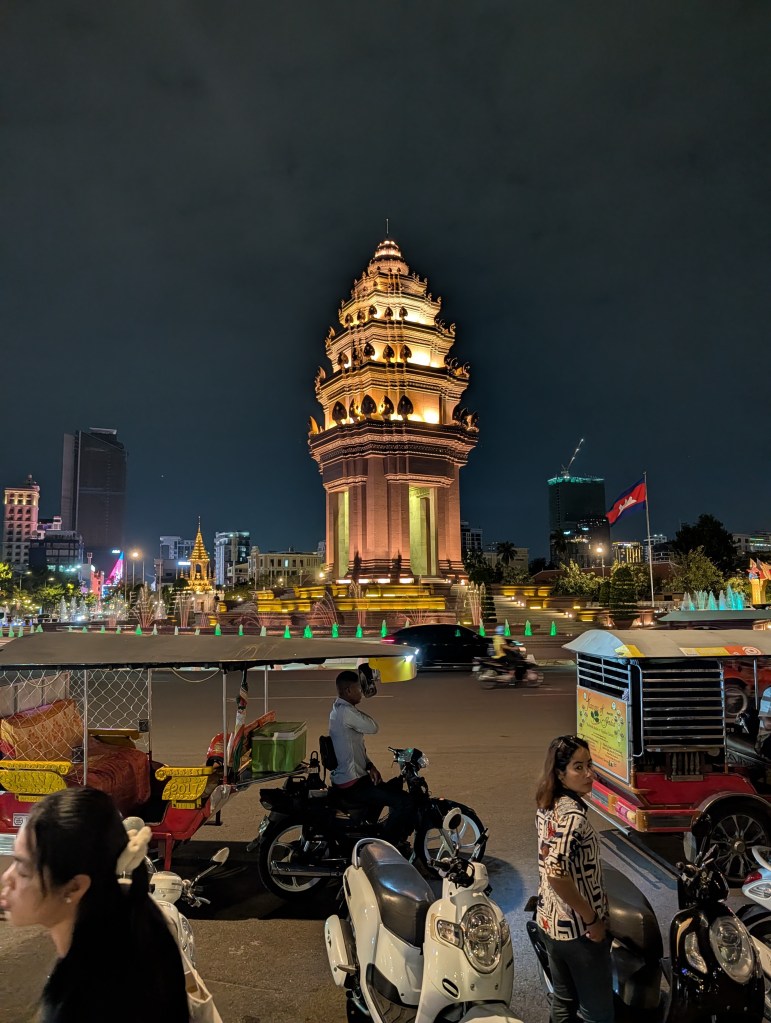
On our first full day in Cambodia we woke up early — which was surprising as I had expected to be utterly wiped out after the flight. Apparently my body decided that sitting in a chair for 30 hours didn’t count as “real fatigue” so I didn’t deserve real sleep.
At breakfast we met one of our fellow tourists on the Lost Plate tour, S., a nice American lady who lives and teaches in Seoul. We chatted a bit and discovered she’s originally from Mississippi, which led to a little mid-South bonding. And then Dr. Kelly and I decided to take a plunge into Phnom Penh.
Sadly, Zhou Daguan didn’t mention Phnom Penh at all, probably because it didn’t exist under that name back in 1296. Apparently there was a small settlement on the site around a temple on a hill, and that may be the “Buddha village” that Zhou mentioned passing in the course of his journey from the mouth of the Mekong to the capital at Angkor, but other than name-checking the place he doesn’t discuss it.
(Twenty-First Century First World Problems Dept.: I keep bitching about spending 30 whole hours in transit from New England to Indochina. Meanwhile poor Master Zhou and company spent 15 or 20 days traveling upriver from the Mekong delta to the area around Phnom Penh. Considering that Google Maps thinks that’s only 3 days of hiking nowadays, it’s pretty obvious that southeast Asia was a lot harder to get around in 700 years ago.)
Henri Mouhot, on the other hand, stopped at “Penom-Peuh” (Phnom Penh) during his expedition into Cambodia and had this to say:
“The town is situated at the confluence of two great streams, and contains about 10,000 inhabitants, almost all Chinese; but it has a floating population of more than double that number, composed of Cambodians and Cochin-Chinese, living in their boats. (…) Having traversed the city, which was long and dirty, I arrived at an eminence on which was built a pagoda, possessing neither beauty nor interest, but from whence there is a view over a large tract of country.”
A lot has changed since 1860. Phnom Penh is now a huge city, with a population about the same as Chicago’s. Construction is everywhere — the skyline, which already boasts a healthy crop of skyscrapers — is dotted by cranes and the skeletons of buildings going up.
We spent about an hour walking in a half-mile loop to the north of our hotel, with no real destination in mind. The biggest single problem with walking in Phnom Penh (and, it turned out, almost every other place we visited on this trip) is the absence of sidewalks. On all but the biggest avenues they either don’t exist at all, or they’re occupied by food stalls or parked vehicles. So we wound up walking on the edge of the street most of the way, braving the traffic.
I guess this is a good place to talk about traffic in Phnom Penh. The predominant vehicle is the Honda 50cc scooter. They are everywhere, in great numbers, serving a variety of roles. Some carry single riders. Some carry a family of five (7-year-old standing up in front peeking over the handlebars, Dad driving, Mom behind him with an infant or toddler wedged in between, and 9-year-old standing up on the seat behind Mom; if anyone’s wearing a helmet it’s Dad, but probably not). Some pull cargo trailers that wouldn’t look out of place behind a Ford F150 pickup truck (apparently you can redline a Honda two-stroke engine for years with no ill effects). A great many serve as propulsion for small open-sided taxis known as tuk-tuks, which were our primary mode of travel on the tour. A surprising number were delivery vehicles for the Grab food delivery service.
At first glance the roads look completely chaotic. Lane markers and stop signs are treated as suggestions at best, and even traffic lights are obeyed only when there is actual cross traffic to wait for. They mostly drive on the right, except when they don’t. There are no crosswalks at all — pedestrians simply barge out into traffic, confident that the scooters and occasional cars will go around them. (The trick is to maintain a steady, predictable walking pace.)
And it all works, somehow. In Cambodia I never saw an accident, or the aftermath of one, and seldom heard a horn honk or even anything that sounded like an angry comment. I think there are three reasons why traffic in Cambodia looks nightmarish but isn’t. The first is that it’s all fairly slow. The stream of vehicles are all moving at the speed of a Honda 50 with a family of five on board. Nobody’s trying to bang along at 45 miles per hour on a city street, they’re barely making 20. This means plenty of time to react to traffic and pedestrians.
Second, there’s a kind of “mutual assured destruction” concept in play. When everyone’s on a scooter, with approximately 0.2 helmets per person and no seatbelts anywhere, a collision is going to hurt. The solution, obviously, is not to have collisions. So they are all fairly “defensive” drivers. They don’t take risks. Coach Reginelli, who taught me to drive in 1982, would approve.
And finally, I think Cambodians — at least, all the ones I encountered — just don’t turn into jerks when they start up a motor. Everybody seemed quite tolerant of clueless tourists learning the rules of the road, and nobody seemed desperate to get that one extra car length ahead no matter what. Maybe being out in the open where you have to meet the eyes of other drivers, rather than sitting enclosed in a box with tinted glass, makes one more less aggressive. Maybe it’s Buddhism. I don’t know. I’ll just say they should find out the reason, bottle it, and ship it to Boston in ton lots.
Our first reconnaissance into Phnom Penh was fascinating, even though we didn’t see any “sights” that show up on a map. It’s not a beautiful city — most of the old colonial architecture got blown up by the Khmer Rouge in the 1970s, and the stuff that replaced it is functional but not enchanting. Tropical climates are hard on buildings, and concrete in particular does not get more handsome as it ages. M. Mouhot’s description of Phnom Penh as “dirty” still seems to apply: there’s a lot of casual litter, especially windblown plastic bags, and since we were visiting in the dry season, plenty of dust.
So what did we see? FISH LEOPARD GATHER HOTEL. Robed monks carrying orange parasols. The first of many, many, 7-11 stores. Fantastic tangles of fiber-optic cables strung along the sides of buildings. AWESOME GLOBAL CENTER. Food stalls, workshops, and tiny market stalls along every street — basically every building except posh hotels and government ministries has retail space on the ground floor. 15GB $15. Lots of English signage. Scooter hauling a trailer load of fresh coconuts. STARBUCKS.
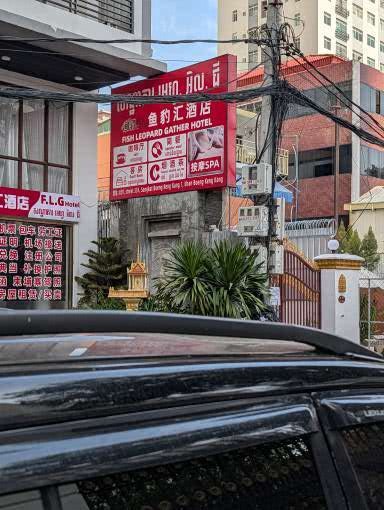
It may not be pretty but Phnom Penh is interesting. It’s extremely cosmopolitan and full of commercial energy. I expect it’s a great place to be an expat entrepreneur. Get your 15GB, get an office in the Awesome Global Center, buy a Honda scooter and you’re in business.
We got back to our hotel, had a nap and got cleaned up, then met our guides and fellow tourists for our first grand outing. The group consisted of ten people in all: Diane and myself; S., who I’ve already mentioned; B. and V., a young couple from Ireland who spent time teaching in Beijing; E. and A., a slightly less young couple from Australia; E., a Lost Plate employee going along as a guest; our primary guide Songheng, and a trainee guide called Suiheng. We introduced ourselves, were issued Lost Plate tote bags and our own krama — Cambodian cotton scarves.
Going by Zhou Daguan’s account, there was a time when the krama was pretty much the entire wardrobe of most Cambodians. “From the king down, the men and women all wear their hair wound up in a knot, and go naked to the waist, wrapped only in a cloth.” But in the intervening centuries they have become some of the most buttoned-up people in the world. I don’t think I saw any Cambodian adults wearing short pants, and most of them had long sleeves. The weather was in the upper 80s and low 90s (Fahrenheit) but many people had jackets and nearly all wore hats. I asked more than once why this was so, and the invariable answer was that they’re trying to protect their complexions from the sun.
Kramas in hand, the ten of us boarded three tuk-tuks for a street food tour of Phnom Penh. The ride was a bit bouncy, but the streets of the city are no worse than, say, Northampton in Massachusetts. Not much heavy truck traffic and no snowplows digging divots from the pavement helps a lot.
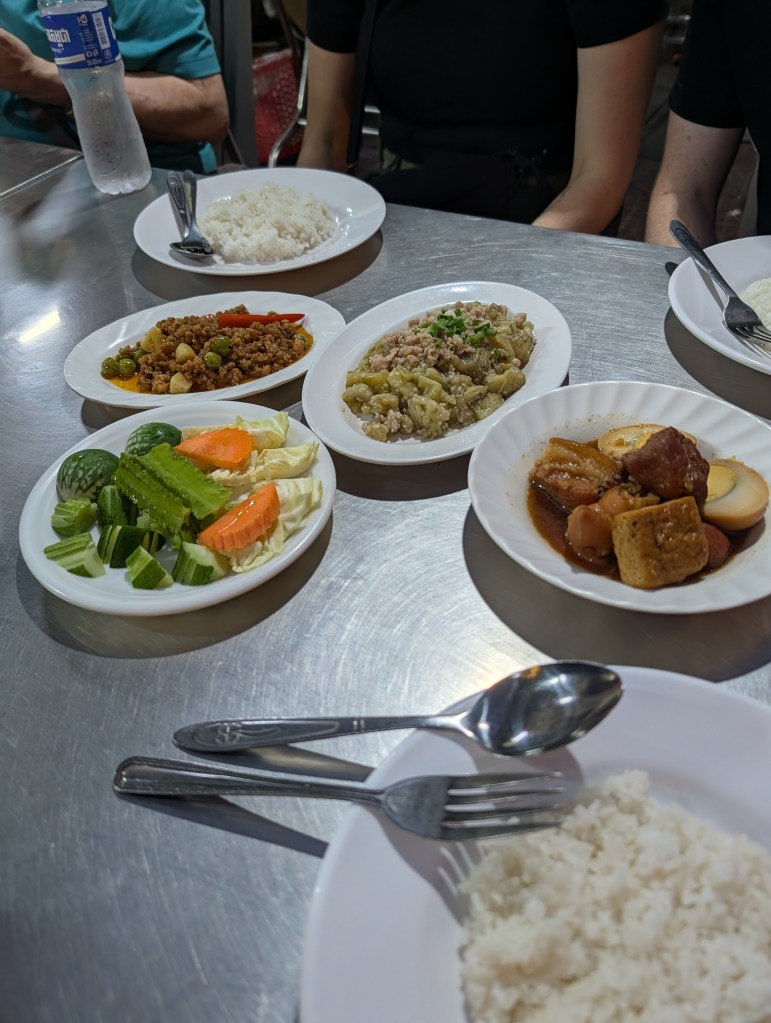
Our first stop was downtown (and I apologize for not knowing exactly where some of these places are or what the restaurants were called): a noodle restaurant where we tried Nom Banh Chok, a noodle dish with fish. Then inland to a neighborhood not far from our hotel where we stopped at a place specializing in fermented fish paste. The food there was minced pork with fish paste and tiny eggplants, fried eggplant with pork, and a very rich stewed pork dish (see photo).
Then on to a Euro-Cambodian restaurant for banana flower salad with beef, and a chicken curry. Finally to the “Russian market” for some street food on a real street, where we sampled grilled pork ribs, sticky rice, and mochi. Along the way we passed by the monument to independence (at the top of the post), and a statue of King Sihanouk — a man who could have taught Talleyrand a thing or three about landing on your feet during regime changes.
After the Russian market (which got the name during the 1970s and 1980s when Russian tourists shopped there to make their travel rubles last longer) we finished up with a drink at the Upstairs Bar, which overlooks the market square and had some local craft beers to try. I’m not a beer guy and the result was not really to my taste. I liked Ganzberg and Cambodia, the local cheap beers, considerably more.
And after all that, feeling very full, we tuktukked back to the Rambutan and to bed.


One response to “The Great Indochina Expedition, Episode 2: Phnom Penh”
[…] Next time: into Phnom Penh! […]
LikeLike