
Note: not many photos this time. Sorry.
On January 10 we checked out of our hotel in Ayutthaya and boarded the Party Van for the drive to Khao Yai National Park — a distance of about 150 kilometers. That’s nothing — closer than my town is to Boston. Two or three hours, right? Be there by lunchtime.
Not quite. First of all, the road from Ayutthaya to Khao Yai isn’t a high-speed limited access road like the Mass Pike. It’s a four-lane blacktop lined with factories and businesses, with far more traffic than the road was designed to handle. We moved at no more than 40 kilometers per hour for most of the trip, and spent at least one hour moving at about 2 kph navigating through the absolutely choked streets of Saraburi.
That’s the flip side of Thailand’s rapid — and very successful — push for industrial development. Hundreds of thousands of people have moved from tiny rural villages to bigger towns for factory and office jobs, and some of the towns grew too fast to accomodate all the new traffic.
Frankly, the drive was a lot less entertaining than our ride across Cambodia two weeks earlier. The scenery was not exotic and the traffic wasn’t nearly as much fun to look at. There were a lot more trucks, and their drivers were more aggressive. We did make one pit stop at a rest area, where I discovered that outside the cities, the men’s room is often out in the open air.
Things started looking up once we left the big trunk road (which continues on to Vientane in Laos, with Hanoi and all of China beyond) and turned south into the Khao Yai mountains. They’re pretty decent mountains, at least by my lowland standards. The highest peaks are about 1300 meters, which beats anything in the Poconos or the Ozarks. It’s a rural area devoted to timber and livestock, and the park itself covers more than 2000 square kilometers. It’s the oldest national park in Thailand, dating back to 1962.
We stopped for lunch at a lovely restaurant with a nice view of the mountains. The astonishing thing about them is how much they look like mountains in east Asian art. That may seem odd to say, but if you’ve seen much Chinese or Indochinese art you’re probably aware of how different the mountains in their ink drawings look from mountains in European art. Lots of steep-sided “sugarloaf” shapes rising from basically flat valley floors. Very different from the ridges and cones of European and North American painters. I had always assumed it was an artistic convention, but no, it’s an actual difference in geology.
My suspicion is that mountains like those are what you get when you farm a region continually for about four thousand years and keep going up into the mountains to harvest wood for fuel and building. With no trees and abundant rainfall, erosion gets very rapid. Everything but the rocky core of the mountain washes away. (Any geologists are welcome to correct this theory.)
Our lunch was a delicious papaya salad with grilled chicken, and I even indulged in a Singha beer. After that it was just an hour or so more to our hotel, the Intercontinental Resort.
Remember when I compared the Khao Yai mountains to the Ozarks or the Poconos? There’s a reason I did that: the mountains serve a similar role in Thailand as those areas do in the U.S.A. Lots of vacation homes and resorts are clustered in the towns outside the park, and we saw many billboards advertising future developments. Some of them are kind of odd. We passed one vacation development which was built to mimic a medieval Tuscan hill town, complete with a straightened-up Tower of Pisa as the main hotel. Another resort was built like a French chateau, and I saw signs for a cowboy-themed place.
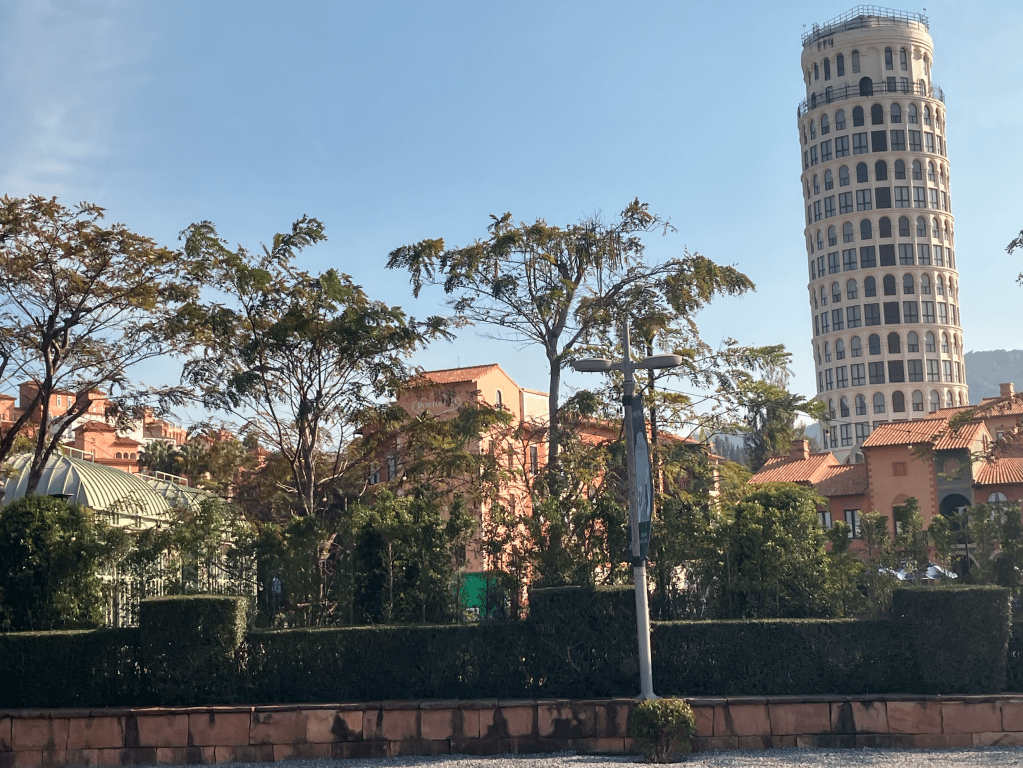
Interestingly, almost all of the billboards promoting vacation properties were in English. I didn’t get a good sense of who stays in all the theme resorts, or rents the summer cottages. Is it prosperous Thai families looking for a place to get away from the heat and bustle of Bangkok? Or foreigners who want a taste of rural Thailand? Most of the people we encountered at our hotel were Americans and Europeans, but I’m not sure if that’s true all the time. I find it hard to believe people would travel all the way to Thailand to stay in a faux-Italian resort — why not go to Italy for that?
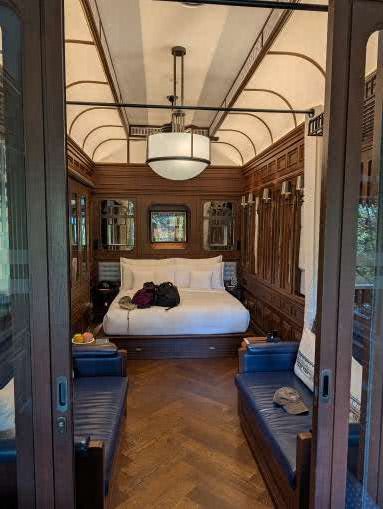
The Intercontinental Resort is railroad themed, and the designer went all in on the concept. Our room was built like an oversized sleeper compartment from a passenger train of the interwar era, and all the fixtures were made to look like stuff from a train car. For real purists with deeper pockets, the hotel actually has some vintage railroad cars to stay in. The fanciest restaurant is in an old dining car (more on that later).
Our friend Henri Mouhot doesn’t seem to have visited the Khao Yai region. He stopped at “Mount Phrabat” near Saraburi, which I guess is what’s today known as the Wat Phra Phuttabat Ratchaworamahawihan temple northeast of Ayutthaya. Presumably M. Mouhot shortened the name to save pages in his notebook. He seems to have headed north from Saraburi toward Laos. I expect the Khao Yai area was pretty much wilderness at the time — and not the kind of wilderness with theme resorts and fancy restaurants.
Just before sunset we got back into the Van and drove to the Khao Yai Bat Cave, where about a million bats live. As bats do, they sleep in the cave all day and then stream out at sunset to hunt insects all over the region. There’s even a restaurant/bar across the road from the cave with a viewing area, so we settled in comfortably and watched the bats. The sight was impressive, and Dr. Kelly’s handy telescope let us see the stream in more detail. It required more than 20 minutes for all the bats to leave the cave. We followed this with a late supper at the hotel and bed.
One thing I discovered while bat watching: up in the highlands it can get rather brisk after dark. We had to dig out the winter clothes we hadn’t worn since landing in Phnom Penh, and were glad to have them. Indochina is generally warm all year — Bangkok sits on roughly the same parallel of latitude as Tegucigalpa, the capital of Honduras — but altitude makes a huge difference. There are snow-capped mountains in Ecuador and Tanzania, right on the Equator. It’s a good thing the Thai government grabbed the land for the park when they did, because I expect the milder climate of that area is going to keep attracting new people for a long time.
Next time: Welcome to the Jungle!
 The Cambias Digression