
January 6 was another lovely day, though not quite as busy. We rode aboard the Party Van to the west bank of the Chao Phraya river for a visit to the Wat Arun temple complex in the Thonburi district. Wat Arun can be translated as “Temple of Dawn” and sits just across the river from the palace.
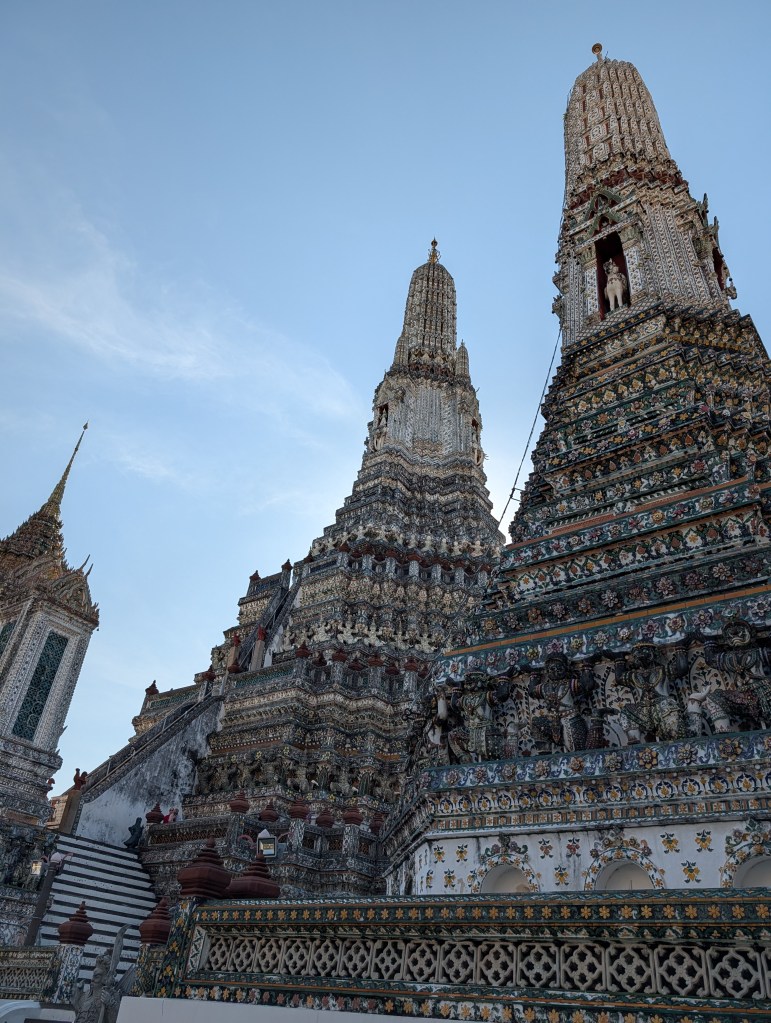
While the early kings of the Chakri dynasty have their memorials over in Wat Phra Chetuphon next door to the palace, Wat Arun holds the monument to King Taksin, who chased out the Burmese after the destruction of Ayutthaya and moved the capital to Bangkok (although his capital was in Thonburi). Here’s M. Mouhot’s account of that remarkable ruler, picking up just after the fall of Ayutthaya:
“As much by stratagem as as by force of arms, he gained possession of the northern districts; but, not deeming himself secure enough from hostile attacks in that part of the country, he decided on falling back towards the south, and established himself at Bangkok, having previously surprised and put to death Phra-Nai-Kong, the Burman governor of that place, and seized on a quantity of money, provisions, and ammunition. Its proximity to the sea afforded many advantages, one being that escape would be tolerably easy should fortune prove adverse to him. He there built a palace on the western bank of the river, near the fort, which is now standing.
“After various encounters with the Burmans, he reduced them into subjection, mainly through the assistance of his flotilla; and on one occasion he overpowered their while camp, recovering great part of the booty they had amassed, and finally freeing the country from those bitter foes, who had brought into it so much desolation and terror. The people, in gratitude to their deliverer, gladly aided him in his assumption of royal authority. (…) Thus, by the end of 1768, he found himself sovereign of all the southern part of Siam and the eastern provinces on the shores of the Gulf.”
I’m skipping past some battles and romantic intrigues. Poor Taksin had an unhappy ending.
“…in the latter part of his life he fell into a state of morbid melancholy, treated his subjects with cruelty, and lost his popularity. One of his generals, Chakri, commanding in Cambodia, took advantage of these circumstances to concert a plot against the King, who was taken prisoner at Bangkok, and assassinated in the year 1782. Chakri ascended the throne, and, dying soon afterwards, was succeeded by his son.”
Note that M. Mouhot had to rely on accounts either written by members of the Chakri dynasty or their court for this history, so King Taksin might have given a different version of how the transition happened.
Taksin is still viewed as something of a national hero, and the Wat Arun temple is very beautiful and impressive. We climbed up some steep stairs to admire the view from the parapet of the main pagoda.
At Wat Arun we noticed a number of other visitors — mostly tourists from other countries in eastern or southeastern Asia — dressing up in rented traditional Thai costume to have their photos taken. None of the Thais around seemed to mind. Evidently they don’t have enough helpful Americans to tell them that cultural appropriation is very, very naughty and they shouldn’t do it.
We boarded a “long tail” boat at Wat Arun for a cruise around the canals of Thonburi. Long tail boats are curious hybrids — a long narrow hull with a high prow, obviously originally designed for multiple rowers, but propulsion is a small car engine mounted on a pivot with the propellor shaft sticking straight out behind for ten or twelve feet. The boatman can steer by turning the motor, or lift the prop out of the water in shallow areas. Our guide said they are sometimes called “James Bond boats” because Roger Moore got to zip around in one in The Man With the Golden Gun.
Bangkok (as M. Mouhot noted in an earlier entry) is often compared to Venice, with lots of canals criscrossing the city, both for drainage and transport. However, in much of the city the canals are no longer passable by boats. The demands of surface motor traffic means that most of the canal crossings are now grade-level bridges, and since the water level is just a couple of feet below ground level, there just isn’t room for boats to fit under them anymore.
But across the river in Thonburi the bridges are taller and the canals see a lot more use, by tourists like us cruising around, locals riding water taxis to get where they happen to be going, and more utilitarian craft making deliveries. There are several active boatyards along the canals. Our long-tail passed through some locks and we spent a very pleasant hour watching the houses of Thonburi slide past. Along the water, the SOPI is 2 or higher. Some of the canals are artificial, others are obviously natural tributary streams of the big river. I don’t know what the Thai word for “bayou” is, but that’s what they are.
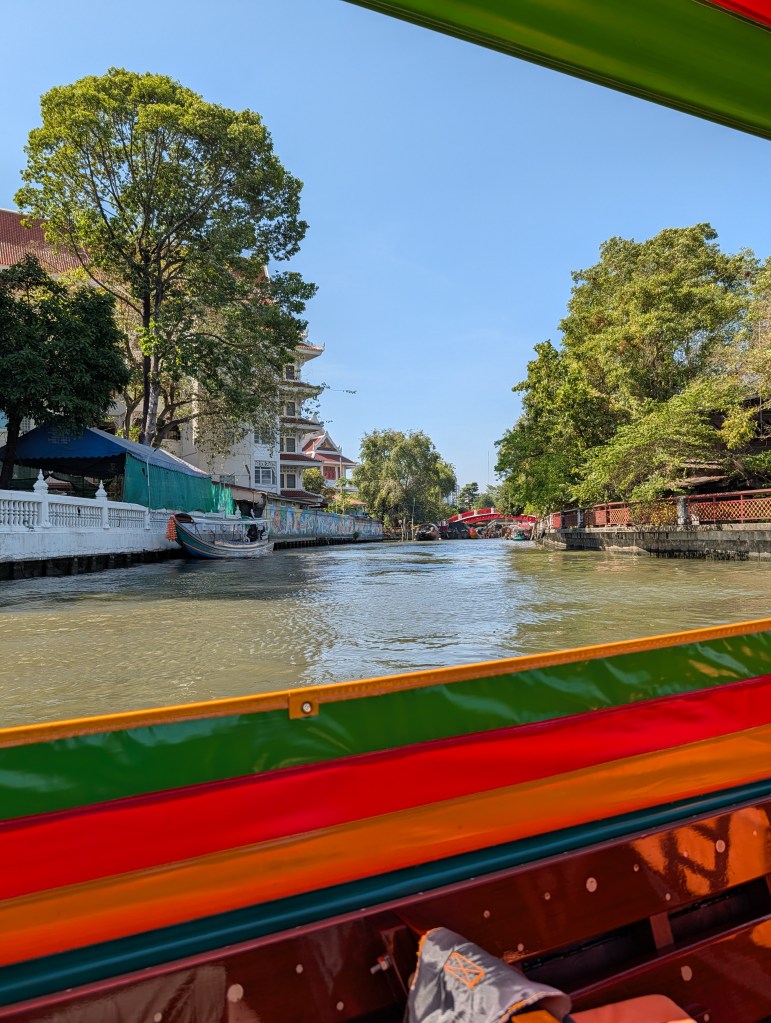
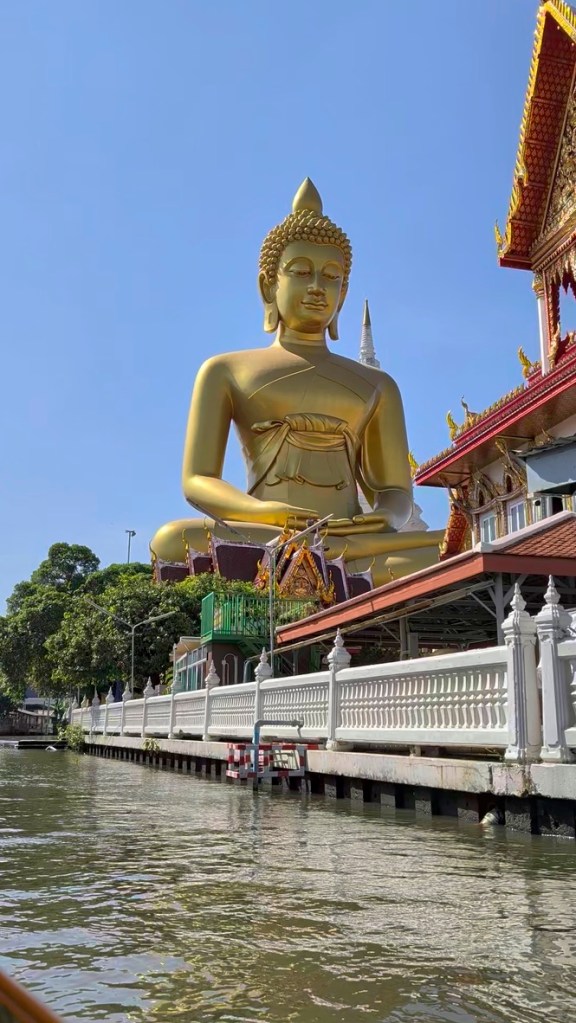
Dr. Kelly was pleased to spot monitor lizards in the water, and we had a look at the immense Buddha statue looming over the Wat Paknam Phasi Charoen complex.
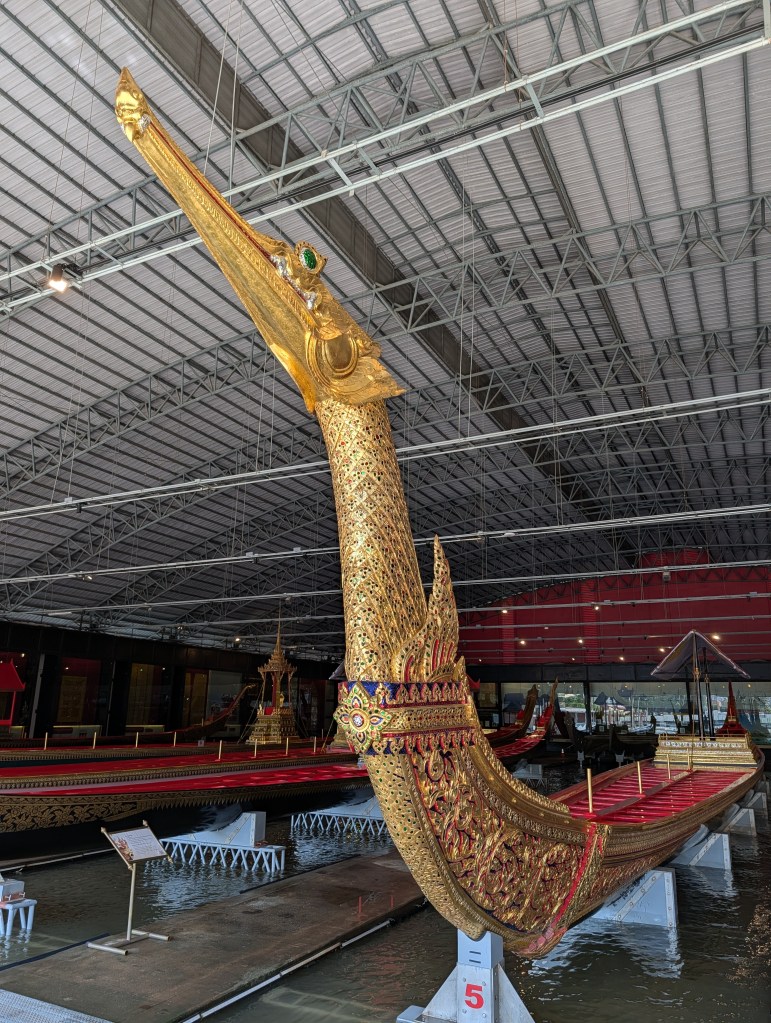
Our cruise ended at the Royal Barges National Museum, located just where the Bangkok Noi river meets the Chao Phraya. This is where the fancy ceremonial barges used by the Royal Family are kept. These barges are about as old as I am. The originals, dating back to the 19th century, took a stray bomb during World War II (the Thonburi railroad station is nearby) and weren’t reconstructed for a couple of decades. They’re lovely to look at, and it would be great to attend one of the festivals when they get put in the water.
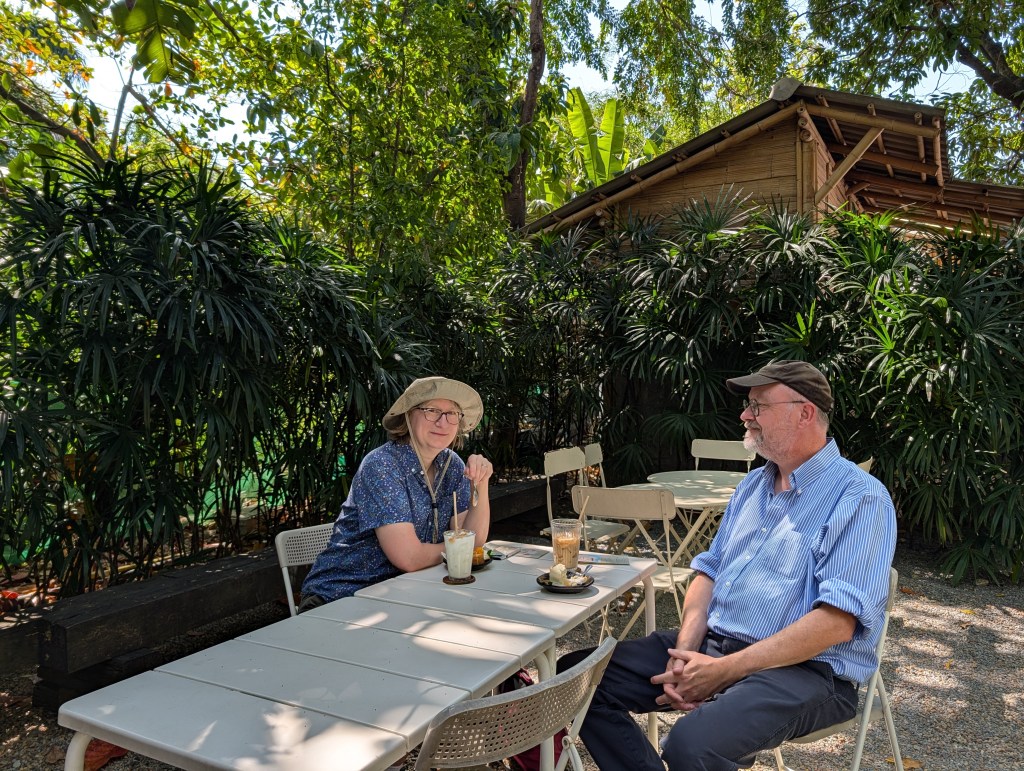
Back on dry land we rode the Party Van to the Poomjai Gardens, a lovely little oasis of greenery on the southwest side of Bangkok, where we sat in the shade of a banana tree and had snacks and iced coffee.
That was it for our tour destinations during the day, so we indulged in a swim and nap at the U Sathorn before getting dressed up and strolling over to the ultra-fancy Nahm restaurant, located in the COMO hotel on Sathon Road. We ordered the “heritage tasting menu,” which consisted of:
(Spanish Cava)
Blue swimmer crab and pickled garlic on a rice cracker
Miang of river prawn, chicken, and mango on a betel leaf
(Chablis from Granmonte Winery, Khao Yai)
Spicy lamb curry served on Thai crepes
Grilled banana leaf packet of crab, prawn, and fish seasoned with red curry
(Sardinian white wine)
Tom Yum soup
Fragrant northern-style relish with pork jowl and vegetable
(Burgundy)
Southern turmeric curry of crab with betel leaf and lime
Stir-fried beef with coconut shoots and green peppercorns
Stir-fried fiddlehead ferns
(Riesling)
“Life cycle of coconut” dessert (coconut jelly, coconut creme brulee, and a little coconut cake)
I wish I had noted down the exact wines because the wine pairings were absolutely perfect — not an easy thing to do with such a wide-ranging menu. This was the first Thai meal we got which wasn’t dialed down for our wimpy North American palates. At least, I hope it wasn’t, as some of the dishes were very peppery, particularly the lamb, the red curry seafood packet, and the stir-fried “angry” beef.
Full of food and wine we indulged in a tuk-tuk ride back to the U Sathorn and sleep.
Next Time: Ayutthaya!
 The Cambias Digression
2 responses to “The Great Indochina Expedition, Episode 10: Boating Around Bangkok”
[…] Next time: Boats! […]
LikeLike
[…] and even got a farm wagon ride through the vineyards. Granmonte was one of the wines served with our meal at Nahm, back in Bangkok, and apparently they’ve done a good job of marketing their products […]
LikeLike