
Our flight out of Siem Reap did not take us eastward across the Pacific toward North America. Quite the reverse: we headed west for the second half of our trip. Siem Reap has a brand-new airport, out in the middle of nowhere forty-six kilometers east of the city. It was built and is apparently run by a Chinese company, which was the first sign of Chinese economic presence I saw in a country less than a thousand miles from China by road.
We flew on Bangkok Air, which unsurprisingly took us to Bangkok. After takeoff I managed to get a look at the Tonle Sap lake in the center of Cambodia. Fortunately the ceasefire between Thailand and Cambodia was holding, so the plane didn’t have to make any detours around danger zones.
Bangkok airport isn’t quite as spiffy-new as the ones in Siem Reap and Phnom Penh, but it is still big and impressive. We got through passport control and exchanged some money — unlike in Cambodia, businesses in Thailand don’t accept U.S. currency. The Thai baht was trading at about 30 to the dollar, exactly the same as the Taiwan dollar. I’m sure there’s some interesting story behind that. Then we reclaimed our bags and located our guide.
Our guide was an energetic woman called Sita. We asked her full name, but she laughed and showed us the yard-long Thai surname printed on her tourist guide I.D. and we agreed to let the matter drop. (It’s possible that one reason for the fairly aggressive expansionism of Thailand in the past few centuries is due to the country not being big enough for everyone’s names.)
She in turn took us outside and introduced us to our driver and the vehicle which would be ferrying us around Thailand for the next week — a tricked-out van with disco lights, which will henceforth be known as the Party Van. Safely tucked into the passenger compartment we got our first look at Bangkok during the half-hour ride to our hotel.
Bangkok is what Phnom Penh is trying to become: modern, cosmopolitan, and big. Metro Bangkok’s population is about 16 million people, so if Phnom Penh is the size of Houston, Bangkok is comparable to London or Calcutta. That urban region sprawls across an area roughly the size of Connecticut. Thailand is richer than Cambodia, which means the roads are full of cars rather than scooters. (There are still plenty of scooters, but they’re bigger and faster and carry fewer people.) This makes Bangkok’s traffic a lot more exciting.
Zhou Daguan never got to Thailand, so we won’t be hearing from him any more. But Henri Mouhot spent a fair amount of time in Bangkok. When he was there in 1858 he estimated the population at 300-400,000 people, about a fortieth of the present size. In those days all the traffic was on the water.
“Bangkok is the Venice of the East, and whether bent on business or pleasure you must go by water. In place of the noise of carriages and horses, nothing is heard but the dip of oars, the songs of sailors, or the cries of the Cipayes (Siamese rowers). The river is the high street and the boulevard, while the canals are the cross streets, along which you glide, lying luxuriously at the bottom of your canoe.”
The Party Van made short work of Bangkok road traffic, and dropped us at the U Sathorn hotel in the Lumphini district of Bangkok. The hotel is lovely — a low-rise compound centered on a fancy swimming pool, with a very well-regarded restaurant that we never got to try. The beds are absurd, going beyond “king” size mattresses to something like “God-Emperor of Mankind” size. I could lie on my side of the bed with my arms outstretched, and barely reach the center.
We had a swim in the fancy pool and rested in the absurd bed during the afternoon, then at sunset Sita met us in the lobby for what the tour company described as a “sizzling Bangkok street food tour by tuk-tuk.”
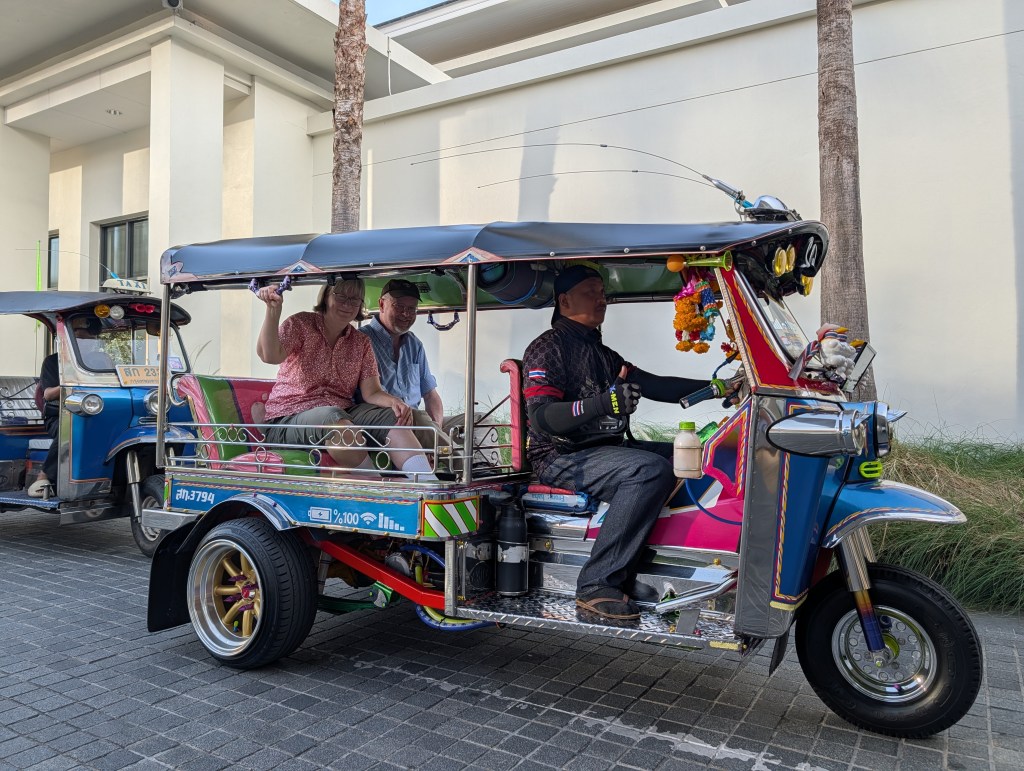
Yes, another tuk-tuk ride. The tuk-tuks of Bangkok are bigger and sturdier than their Cambodian counterparts — instead of a scooter towing a trailer, they’re solidly-built three-wheelers with fancy lights and decorations. For some reason the three of us rode in two tuk-tuks, which meant that our guide wound up shouting tourist information at us whenever we had to stop for a traffic light. Unfortunately, the beefier design of the Thai tuk-tuk also means the roof canopy is lower, which means my view of the city during our tour consisted mostly of parked cars and pavement as the edge of the canopy was about at eye level for me. We bounced along at a very brisk pace through the old heart of the city.
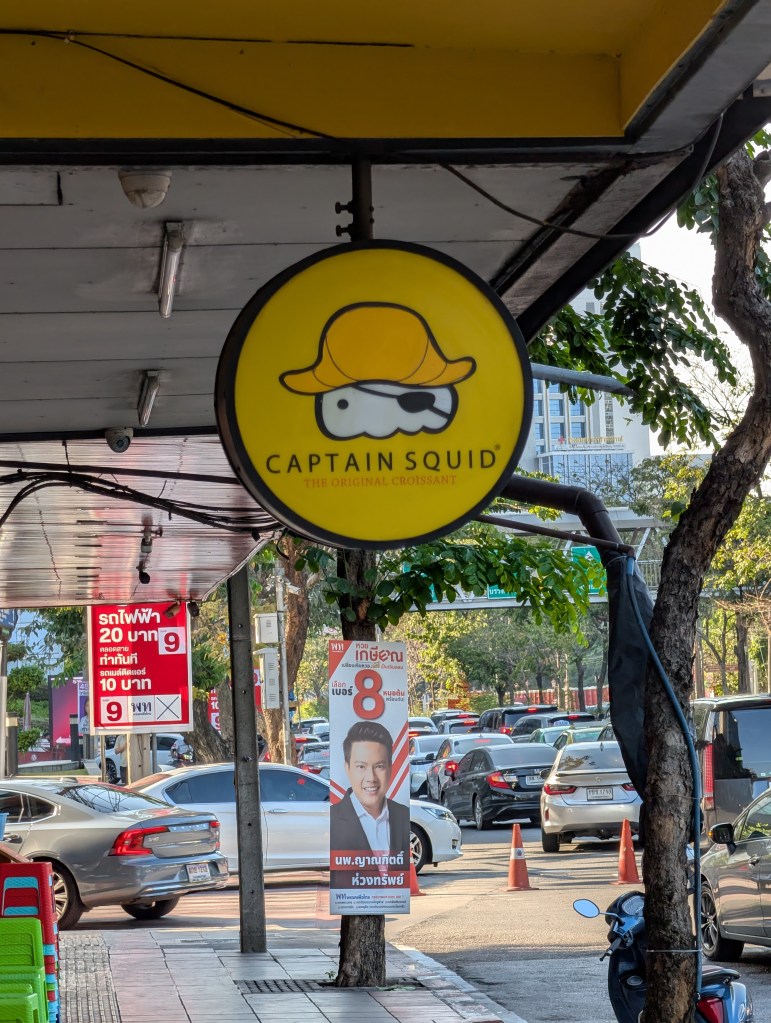
I’m afraid we were both a trifle jaded after the street food tours in Phnom Penh and Siem Reap. The Bangkok tour felt a little tame by comparison. We had Pad Thai at Pad Thai Fai Ta Lu, which has been featured on various cooking and travel shows. Then to a different famous noodle shop (I forget the name) for fried noodles. All quite good — I expect you have to work at it to get bad Pad Thai in Bangkok. We wrapped up our tour at a street market in Bangkok’s Chinatown, which that evening probably should have been called Caucasiantown as European and American visitors outnumbered any actual Asians on the street by a comfortable margin.
That was where Sita tried to really challenge us, with durian: the “forbidden fruit” of southeast Asia. It’s supposed to smell dreadful and taste divine. I’m going to be a big spoilsport here and say that maybe there’s some molecule in durian which I am not sensitive to, because it didn’t smell any worse than your average French cheese, and it tasted more or less like a very dense banana. If there are subtle overtones, I didn’t get them. It’s likely better fresh than neatly cut up and wrapped in plastic.

All of this faint praise might sound as if I didn’t like Bangkok, but that’s wrong. I liked it a lot — it has the same energy as Phnom Penh, just a generation or two farther along the development track. If Phnom Penh seems like a good place for a kid in his twenties with a few thousand bucks and a big idea to start something, Bangkok is where the guys who hit the big score back in the 1990s hold their corporate retreats and put fancy dinners on the expense account. It’s got smoother edges. There are crosswalks, and drivers mostly obey the traffic lights. SOPI is about 1. You’re visiting a major cosmopolitan city, not a place just opening to the world (which isn’t really true of Cambodia, but it has a bit of that feeling still).
Stuffed with noodles and fruit, we tuktukked back to the U Sathorn hotel, got ready for bed, waved goodnight to one another across the vast expanse of sheets and pillows, and slept.
Not many photos with this episode, but the next several posts will make up for that.
Next time: The Kings and I
 The Cambias Digression
One response to “The Great Indochina Expedition, Episode 8: The End of the Beginning”
[…] Next time: cue Murray Head! […]
LikeLike